











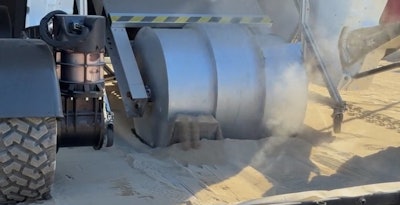
Two companies preparing for the day when construction moves to the moon report they have successfully tested a prototype lunar excavator performing a site-prep simulation.
“This milestone marks the first in a planned suite of automated lunar construction solutions designed to pave the way for future lunar construction projects,” a recent press release says.
The test was conducted here on Earth by Astroport Space Technologies of San Antonio, Texas, and Venturi Astrolab of Hawthorne, California. (To watch the demo, check out the video at the end of this article.)
Astrolab created a rover, which serves as the carrier machine for Astroport’s attachments. In the recent test, Astrolab’s Flexible Logistics and Exploration (FLEX) rover was linked to Astroport’s UTIPA Excavator attachment. (UTIPA stands for Universal Tool Implement Payload Adaptor.)
How It Works
In a video of the demo, the rover, which has a human operator but could be operated autonomously on the moon, automatically attaches to a drum-type excavator. The quick-attach system allows for fast tool changes without human assistance to enable a variety of construction tasks, according to Astroport.
As the drum excavator revolves, it scoops up sand during the demo, simulating digging lunar regolith, such as loose dust or powdery rock. Once filled, the rover moves out of the sand bed where it is met by a skid steer to haul away the excavated material. The skid steer is meant to simulate Astroport’s lunar material-handler attachment.
 Powered by
The companies say the hauled material could be used for large-scale, autonomous construction projects on the moon, such as mass site preparation and excavation, landing and launch pads for spacecraft, and lunar roadways to establish a supply chain.
The demo was designed as a “foundational proof of concept for a broader family of interchangeable automated tools under development.”
The equipment excavated on average about 207 pounds per 3.5 minutes during the test, according to Astroport.
“Leading with this successful excavator demo proves that our technology is no longer theoretical — it is operational," says Sam Ximenes, CEO of Astroport.


"This is the first of many implements in development that will turn Astrolab's FLEX rover into the 'Swiss Army Knife' of lunar construction."
Astrolab’s goal is to establish “a viable lunar ecosystem,” says its CEO, Jaret Matthews.
“By combining our FLEX rover's versatility with Astroport's civil engineering expertise, we are delivering the essential capabilities required for a sustainable lunar economy."
Other Equipment Manufacturers Join Space Race
Manufacturers like Caterpillar, Komatsu and Vermeer have also been involved with developing construction equipment for the moon.
Most recently, Vermeer and Seattle-based company Interlune revealed a full-size prototype “excavator” to dig up dirt on the moon at 100 metric tons per hour to harvest helium-3.
In 2024, Komatsu brought in lunar resource development company iSpace to consult on its development of lunar construction equipment.
And as far back as 2013, NASA awarded seed funds to Caterpillar to develop machines that could help with mining, grading, trenching and other moon operations.
Watch Lunar Excavator in Action
Check out the video below of the demonstration of the Astroport-Astrolab prototype lunar excavator: