











A few years ago, fully autonomous construction sites seemed like a fantasy, Caterpillar’s Chief Technology Officer Jaime Mineart told attendees at this week’s Consumer Electronics Show in Las Vegas.
“Jobsites were considered too variable, too chaotic, too hard to map and predict.”
But all of that is about to change.
The company announced new intelligent machines across five product categories, powered by partners like Nvidia and advances in computing and AI, as well as advanced telematics.
Intelligent product lines will include:
- Excavators: Autonomous trenching, loading, grading and more.
- Loaders: Material handling and truck loading, powered by autonomous navigation and real-time data processing.
- Haul Trucks: Autonomous hauling and distribution of materials, like sand, soil and rock.
- Dozers: Precision grading and earthmoving for optimal efficiency.
- Compactors: Automated surface preparation, ensuring consistent quality and safety.
- Site Optimization: Cat VisionLink and Cat MineStar site systems connect fleets and enable coordinated, intelligent operations across the jobsite.
While the consumer-focused trade show offered limited detail, we suspect additional technical information will be unveiled at ConExpo 2026, where the solutions will also be on display.
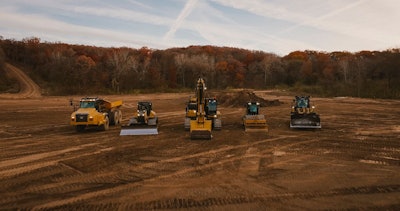
A video shared on the company's CES resources site revealed specific model numbers for some of the machines: a 745 haul truck, a D5 dozer and a CS12 compactor. Model numbers were not visible on the large excavator or wheel loader, but all machines were shown completing tasks without an operator in the cab. Get a first glimpse in the video below:
Caterpillar says its autonomous solutions are built on a foundation of AI, machine learning, computer vision and edge computing that process sensor data in real time and serve as “a digital nervous system for customers’ jobsites.”
 Powered by
Integrated LiDAR, radar, GPS and high-resolution cameras work together to create a constantly updated 360-degree digital view of the jobsite, enabling precise and reliable autonomous operations.
The machines can “make split-second decisions based on billions of data points.” This accelerates human validation and informed oversight, Mineart said, “ensuring speed without sacrificing control, even in the middle of chaos.”
Autonomy in Action
While autonomy has been prevalent in mining for decades, it is now making its way into quarry environments and construction sites.
Caterpillar recently teamed up with Luck Stone, the nation’s largest family-owned producer of crushed stone, sand and gravel, to automate the company’s Bull Run Quarry in Chantilly, Virginia. The partners worked side by side to redefine operations, train employees and identify solutions that best fit the site.


A fully driverless fleet was launched at the site just over a year ago, and since then, Caterpillar says its 100-ton trucks have safely hauled more than 2 million tons of material. The milestone is a first for Caterpillar in the aggregates industry.
Mineart says autonomy has done more than move rock at Luck Stone, it has created safer jobs, greater productivity and new opportunities. “Operators and site managers have moved out from behind the wheel, and into new roles, managing fleets, and optimizing side operations through data-driven decisions.”
Decades in the Making
Caterpillar’s journey to autonomy has been more than 30 years in the making. Here’s a brief history:
- 1980s: A partnership with Carnegie Mellon, pioneering early software, GPS and perception systems, led to Caterpillar’s first autonomous truck tests.
- 1990s: Caterpillar teams advanced capabilities in sensing, positioning and control, which became the foundation for today’s autonomous equipment.
- Mid-2000s: Caterpillar’s work with the DARPA Grand Challenge enhanced perception, decision making and real-world testing under extreme conditions, making the company among the first to deliver Level 4 autonomy: machines that operate independently.
- Today: Caterpillar’s autonomous mining fleet has moved more than 11 billion metric tons of material, traveled more than 385 million kilometers autonomously, more than twice the autonomous mileage of the automotive industry without a single injury reported.
“Now, we didn’t take on automating the largest equipment in the world just for the thrill of it,” said Mineart. “We did it because the industry was changing fast and with it, growing demand, labor challenges and a constant need for greater productivity. Autonomy helps our customers scale up, control their costs and protect their people.”
See More at ConExpo 2026
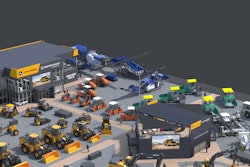
Caterpillar plans to spotlight its autonomous solutions at ConExpo 2026.
The company will have exhibits in the following locations:
- Festival Grounds, Exhibit F29929, will feature the Operator Stadium, which will host the nine finalists participating in the company’s third Global Operator Challenge, as well as a comprehensive lineup of heavy equipment.
- West Hall, Booth W40416, will be dedicated to Caterpillar’s compact construction machines.
- South Hall, Booth S80229, will showcase the company’s latest industrial diesel engine options.