











Purdue University has successfully demonstrated a new method for charging electric heavy-duty trucks: the road itself.
The university recently published the results of a successful attempt to wirelessly charge an electric heavy-duty truck, traveling at highway speeds, using a quarter-mile stretch of U.S. Highway 52/U.S. Highway 231 in Indiana.
Described as “dynamic wireless power transfer,” Purdue engineers designed transmitter coils and installed them within the concrete pavement, and those coils send power to receiver coils on the truck’s undercarriage.
Similar technology is already in use for wireless smartphone charging and other, similar projects for EVs. For example, about two years ago, Michigan DOT claimed to have won the race to build the first wireless electric-vehicle-charging public road in the U.S. with a quarter-mile strip in Detroit.
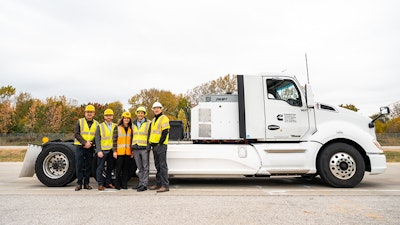
 The embedded coils are powerful enough to charge an electric heavy-duty truck traveling at 65 miles per hour.Purdue University photo/Kelsey Lefever
The Purdue patent-pending charging system was installed into the road by the Indiana Department of Transportation, and the prototype Class 8 electric truck was provided by Cummins.
“With its high power and promising cost structure, this technology represents a practical, and potentially game-changing, solution for the future of on-highway commercial transportation,” said John Kresse, chief technology engineer at Cummins.
 Powered by
This mode of charging EVs has been tested before in other states and countries, but its application onto highways and the heavy trucking industry – where higher speeds require greater energy – is novel. The coils from Purdue are powerful enough to allow one truck to be outfitted with just one receiver coil assembly instead of multiple low-power versions of the same coil.
Purdue engineers were able to deliver 190 kilowatts to the truck as it traveled 65 mph.
Giving electric heavy-duty trucks a way to charge as they drive, according to Purdue engineers, would allow them to use smaller batteries and thus carry more cargo per trip. This, in turn, would notably reduce the overall cost of EV trucking and hopefully attract more investment for this technology, they say. It could also do the same for EV passenger cars and trucks, as well as lower prices on new EVs.


This test represents the latest step in a multistage research project between Purdue and INDOT that began in 2018, partially funded by INDOT through the university’s Joint Transportation Research Program.
The work was also done in coordination with Advancing Self-Sufficiency through Powered Infrastructure for Roadway Electrification, a fourth-generation National Science Foundation Engineering Research Center involved in several similar wireless charging programs.
Other partners on the project include AECOM, White Construction Inc. and PC Krause and Associates Inc.
Plans for the technology involve further testing, including for other vehicle classes like light-duty passenger cars and trucks, to encourage industry adoption, investment and standardization.