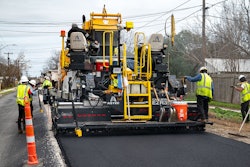











At this year’s Consumer Electronics Show in Las Vegas, Wirtgen America brought a Vögele Super 1700 3-i asphalt paver to demonstrate its new Smart Pave automated control system.
In the video above, Craig Lamarque, vice president of digital products at Wirtgen America, tells how the system can help with the labor shortage by automating certain mundane paving functions. It can also improve safety by removing workers from dangerous positions on the screed and increase savings by more efficient use of materials, he says.
Smart Pave controls the pave width, position and direction of the paver automatically.
Via Smart Pave, the paver follows a digital model created for the specific paving project. The model is transferred to the paver via the John Deere Operations Center telematics system. A John Deere StarFiredual antenna system is permanently installed on the paver’s canopy. It determines the exact position of the paver for high-precision control. (John Deere is the parent company of Wirtgen.)
All hardware components are integrated into the paver, so users don't have to do any assembly work, according to Wirtgen. “Data handling is simple, transparent and leads to the desired result thanks to automatic error analysis."
 Powered by
The system then enables the operator to focus more on material flow management, while the paver follows the project's digital model, Lamarque says.
00:00:00:00 - 00:00:24:11
Craig Lamarque
We're finding it increasingly difficult to first of all, attract talent, let alone attract talent that has any kind of experience. And so what we look to do is find ways of automating certain functions on a machine such that customers can still produce a high quality road at the most cost effective price. And that's really what we're showcasing here today with our smart paver solution.
00:00:37:21 - 00:01:05:08
Craig Lamarque
Really, the starting point is what we do is we help our customers by recognizing there's an opportunity to digitalize the road work and the plan of what needs to be done on a typical roadway. So our customers, we typically work with a consulting company or surveying company to scan the existing road surface and create a digital model in a DXF file of what the final road surface needs to be and where the paver is actually going to travel.
00:01:05:12 - 00:01:32:20
Craig Lamarque
Once the customer has that model built, they can, in their own office, validate that the model in fact meets the engineer spec or the dot spec in length and width, etc. that they are in fact paving in the correct spot. Once they are satisfied that that model is acceptable, the customer then using John Deere operations Center, which is John Deere telematics platform which these machines are connected on, then uploads that file digitally to the selected machine.
00:01:32:22 - 00:01:56:24
Craig Lamarque
Okay, from that point forward, the driver can see and recognize that they received the new file and acknowledge it. Yes, that is in fact the job that needs to be done from that point forward. The steering is then automated, so the driver up there is truly no longer a driver. What he's doing or she's doing is actually then more focused on material flow management, because the machine is going to simply follow the line that's being defined by the digital model, okay.
00:01:56:27 - 00:02:18:02
Craig Lamarque
Similarly, the individuals that stand here managing the edge of the pavement or the edge of the screen, you no longer need to have an individual here. And what we recommend is a single individual standing at the back, simply monitoring that the edge of the screen is in fact complying with the model, which not only has efficiency but also removes the individual from that very dangerous position that I was talking about before.
00:02:18:07 - 00:02:39:19
Craig Lamarque
Okay. So really what we're doing is, again, as I mentioned earlier, automating some of those fairly mundane and in some cases fairly unsafe positions and job sites to a much simpler and much more effective solution that certainly results in more efficient paving. And again, significant savings in material.
00:02:39:21 - 00:03:02:14
Craig Lamarque
Here you see what is oftentimes a typical case with our customers in the paving business, often paving at night because of city restrictions. Authority restrictions where they can't shut down a road during the day. And again, when you've got people on the roadway and especially on a roadway closed to traffic significantly, dangerous. And so our ability to then do everything we can to eliminate that using technology is paramount then.
00:03:02:21 - 00:03:21:01
Craig Lamarque
And that's why we see some benefits here. The other one is time savings. Oftentimes roads and where roads need to be place and pavement needs to be placed is done manually. So somebody out there on an existing roadway marking the edge of the pavement, that is now completely eliminated by virtue of the model that dictates where the where the asphalt is going to be laid.
00:03:21:03 - 00:03:46:07
Craig Lamarque
One of the significant opportunities that we see is material savings. Almost every contract and never wants to underpay is because the consequences of that, by doing penalties or rework is significant. So almost every contractor puts down a little bit more asphalt than they should. Just to be sure. The other thing is the quality of that pavement is almost always never perfect because it relies on a manual person paying attention on the edge of the screen, controlling the edge.
00:03:46:09 - 00:04:05:06
Craig Lamarque
As you see in this graphic here, there's oftentimes more asphalt that needs to be laid. And the interesting stat here is, you know, in in the United States today, we've got about 4 million miles of road, about 3 million miles of that is covered with either concrete or asphalt. When we look at it, over 90% of that 3 million miles is in fact asphalt.
00:04:05:12 - 00:04:31:27
Craig Lamarque
So we've got 2.7 million miles of asphalt in the United States. Now, most folks and engineers will tell you they'd like asphalt to last ten years. Does it? I don't think so, because it depends on a number of factors traffic flow, the quality of how it was laid, environmental conditions. But if we just use ten, ten years as an example, that 2.7 million miles or the ten years equates to 270,000 miles of asphalt covered road that needs to be either replaced or rehabilitated every single year.
00:04:32:00 - 00:04:49:16
Craig Lamarque
And if you can save an inch or two of asphalt on every one of those miles, that results in significant savings for our customers. And also for us, at the end of the day, a lot of the roadwork that's done in this country is really funded by taxpayer dollars. City roads, state roads, federal roads comes out of our tax.
00:04:49:18 - 00:05:06:17
Craig Lamarque
Out of our pocket as taxpayers. And so our ability as a company to help our customers be more effective and efficient in how they lay asphalt really ultimately pays back to us and everybody that drives on the road, because those tax dollars are being able to be stretched a little further. So this material savings is a big one in our mind because of the accuracy of the paving.
00:05:06:23 - 00:05:23:08
Craig Lamarque
And then finally, just some of the benefits that come with automation, we think are really beneficial to our customers in the way I mentioned. And obviously the opportunity to take an individual that would be normally standing on the side and repurpose them to another part of the job that could be helping manage material flow in the front. That can be helping with quality control in the back.
00:05:23:14 - 00:05:31:21
Craig Lamarque
So it's really about repurposing jobs in a way that the job gets done most effectively and most cost effectively, in a timely manner.