











The Maryland Transportation Authority has announced it will not retain Kiewit Infrastructure Co. for Phase 2 of reconstructing the Francis Scott Key Bridge, following consultation with the U.S. Department of Transportation.
In a recent press release, MDTA stated Kiewit’s Phase 2 proposal was “unacceptable, far exceeding the state’s independent cost estimates.” Maryland Governor Wes Moore directed MDTA to “off-ramp” Kiewit and seek other contractors.
According to a USDOT press release, Transportation Secretary Sean Duffy had pushed for the contract to be rebid after “costs ballooned and timelines lagged” under Kiewit.
The price tag for replacing Baltimore’s Francis Scott Key Bridge rose to $4.3 billion to $5.2 billion in 2025, and MDTA expected at that time to open the new bridge to traffic in late 2030. The preliminary estimate was $1.7 billion to $1.9 billion with opening in 2028.
Kiewit issued the following statement on its website concerning the MDTA's decision on the contract:
As part of its progressive design-build contract, Maryland Transportation Authority (MDTA) has elected to move in a different direction regarding the full construction of the project. We respect MDTA’s decision and will continue to coordinate as next steps are defined. As a result of this decision, we will not be advancing into the next phase of work as originally anticipated. Outcomes like this can occur in complex infrastructure projects and alternative delivery models.
 Powered by
Kiewit Infrastructure Company continues to perform work under our current contract with MDTA, including early construction packages already underway, and will remain coordinated with the client as next steps are defined.
Acting Transportation Secretary and MDTA Chair Samantha J. Biddle said that new estimate accounted for higher material costs compared to the preliminary estimate, which came two weeks after the bridge collapsed in March 2024 following a ship strike. That estimate was required at the time for the state to receive federal emergency relief funding. The federal government will ultimately foot the bill for 100% of the cleanup costs from the collapse.


Part of the increasing cost included a longer main span (now 1,665 feet long) and taller main piers to accommodate larger ships and meet new bridge guidelines from the American Association of State Highway and Transportation Officials.
Duffy became more involved with the Key Bridge rebuild in September 2025, when he sent a letter to Moore expressing concerns about the rising costs and extended timelines. The two met in January and secured an agreement to accelerate reconstruction efforts.
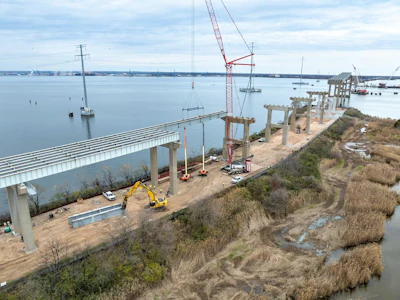
Kiewit won the $73 million Phase 1 Progressive Design-Build contract for the bridge replacement in mid-2024 and received exclusive bidding rights for Phase 2. Kiewit's Phase 1 work, which includes driving foundation piles and building a temporary trestle, is expected to continue through the end of 2026.
The Key Bridge collapsed March 26, 2024, after the cargo ship Dali lost power twice in the Baltimore Port channel and crashed into it. The collapse killed six construction workers who were on the bridge.