











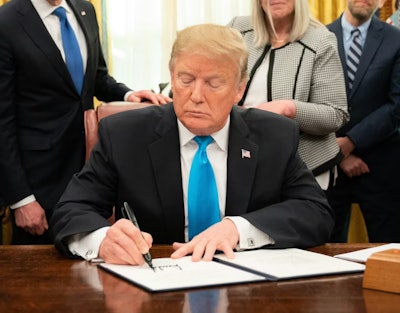
The second administration of President Donald Trump has brought a series of direct and often abrupt changes to the construction industry in 2025. And a majority of contractors responding to a recent Equipment World poll say those changes have been positive overall.
The poll, which generated 89 contractor responses, ran from October 27 to November 14, asking readers if the first year of Trump’s second term had a positive, negative or neutral impact on the construction industry.
Of responders, 60% rated Trump’s actions as positive for the industry. Another 30% said they created a negative impact, and 10% said the impact was neither good nor bad.
Here are some of the changes the construction industry has felt from the Trump administration this year:
Increased ICE Raids
This year has been marked by a large increase in the presence of Immigration and Customers Enforcement on jobsites and a rising number of arrests and deportations of construction workers as a result.
A survey completed in early August by the Associated General Contractors of its members revealed 28% of respondents reported “being affected directly or indirectly by immigration enforcement activities during the past six months.”
AGC said the survey also showed:
- 5% reported “a jobsite or offsite was visited by immigration agents.”
- 10% said “workers left or failed to appear because of actual or rumored immigration actions.”
- 20% reported “subcontractors lost workers.”
 Powered by
ICE raids on construction jobsites were halted during the pandemic under the Biden administration.
EV Charging Funds Withdrawn
Almost immediately after taking office, Trump froze $5 billion in federal funding for states to build electric vehicle charging stations.
More recently, the U.S. Department of Transportation rolled out new guidance for how those funds will be spent.
USDOT provided the following summary of changes:
- Minimizes the content in state plans to statutory and regulatory requirements.
- Simplifies the state plan approval process.
- Aligns community engagement with regulatory requirements and reduces consultation requirements to advance projects.
- Provides states with flexibility to determine the appropriate distance between stations along alternative-fuel corridors to allow for reasonable travel.
- Minimizes requirements for states to consider electric-grid integration and renewable energy.
- Accelerates project delivery by encouraging selection of charging locations where station owners are also the site host.
- Eliminates requirements for states to address consumer protections, emergency evacuation plans, environmental siting, resilience and terrain considerations.
- Provides states with more flexibility to determine when their system is built out, allowing NEVI funds to be used on public roads statewide.
Among the Biden-era language removed from the NEVI guidance are references to engaging with underserved communities, targeting benefits to disadvantaged communities, promoting minority-owned and women-owned businesses and ways for EV charging to support emergency and evacuation needs.
New USDOT DBE Rules
Last month, the U.S. Department of Transportation filed an interim ruling dismantling a Reagan-era program that allocated federal funds to disadvantaged firms.


The interim final rule issued October 3 states the USDOT’s Disadvantaged Business Enterprise and Airport Concession Disadvantaged Business Enterprise programs will now be operated “in a nondiscriminatory fashion – in line with law and the U.S. Constitution.” The ruling specifically removes “race- and sex-based presumptions of social and economic disadvantage” and decrees the program must both help small businesses and serve the public.
By redefining key aspects of the program, including changing terms such as “race-neutral” to “DBE-neutral,” the program will no longer include “presumption eligibility based on race and sex” and will now require small businesses to submit evidence to prove their qualifying social disadvantage, in addition to their economic disadvantage.
Trade Wars
An ongoing issue in the industry is the ever-fluctuating tariffs the Trump administration has levied against other countries.
For example, in April, a series of tariffs were issued by the Trump administration, with the stated goal of rebuilding the U.S. economy and strengthening the country’s international economic position.
But only a few days later, Trump issued a 90-day pause on those same tariffs and lowered reciprocal tariffs to 10%. In a post to his social media platform TruthSocial, Trump said over 75 countries had reached out to representatives of the U.S. to negotiate solutions to the issues given as rationale to implement the tariffs.
Since then, a series of new trade agreements has been reached with other countries to lower or remove tariffs that were put into effect this year.
The first implementation of these new tariffs drew a series of responses and statements from construction industry groups, with some calling for exemptions to protect contractors from their negative effects.
Construction equipment manufacturers and dealers were dealt an additional blow in August with the introduction of a 50% duty rate on “derivative” steel and aluminum products covered by Section 232 sectoral tariffs.
The additional 407 product categories announced by the Department of Commerce on August 19 included mobile cranes, bulldozers and other heavy equipment, compressors and pumps, and hundreds of other products.
In the recent round of third-quarter earnings reports, many manufacturers reported adverse impacts from these new tariffs to the tune of hundreds of millions of dollars.