











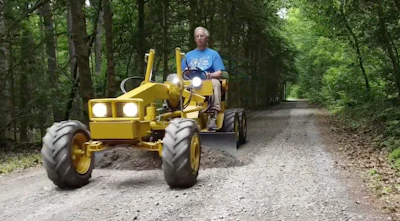
Frank Smith has been building stuff all his life. So when he needed something to groom his gravel driveway, he turned to his favorite brand of lawn tractor.
The result was a 1972 Cub Cadet converted to a mini motor grader. To show his friends his creation, he posted a video to YouTube, so he could send them a link.
“Three months later or something,” Frank says, “I get an email from Google that said, ‘You've had a million views on your video, and you’ve got 5,000 subscribers.’
“I was stunned. I had no idea and no expectation of anything like that.”
Since 2020 when he posted his first video, Frank has invested in a camera and drone to chronicle his metal shop adventures, showing viewers how he converted the Cub Cadet to a motor grader.
He’s gone much further, too, creating a Cub Cadet mini dozer, forklift and Gator-like utility vehicle, posting videos of those to his “Wood & Metal Shop Time” YouTube channel.
“Part of it's just to chronicle what I'm doing,” he says of his videos. “And I enjoy sharing stuff, and I try to teach people what I know about stuff as I learn.”
Cub Cadet Mini Motor Grader
 “Wood & Metal Shop Time” YouTube channel
 Powered by
The motor grader idea came about after becoming frustrated with trying to level his driveway with a blade behind a tractor. He had seen a photo online somewhere of a lawn tractor converted to a mini grader, so he thought he’d give it a shot.
He looked around the internet at photos of full-size graders.
“I copied a typical motor grader mainframe geometry,” he says. “I tried to maintain it as a scale-model appearance so that it would look legitimate.”
 “Wood & Metal Shop Time” YouTube channel
One was getting two hydrostatic transmissions synchronized, so they'd operate in tandem.
Another challenge was building the frame to hold the blade circle and the controls for the blade to rotate it from the operator’s seat.
“There's a hydraulic-operated pin, which goes through holes in the blade circle so that when you get it to the angle you want, drop the pin through a hole,” he explains. “And that takes the load off of the gear, which rotates the blade.”


He transplanted power steering from a 1990s-era Cub Cadet.
For all his creations, he uses the old standard Cub Cadet 12- or 14-horsepower Kohler gas engines. The motor grader has a rebuilt 12-horsepower engine, is 13 feet long and weighs 2,000 pounds.
 “Wood & Metal Shop Time” YouTube channel
“You go back and forth, up and down the lane a couple times, and all of the washboarding and lumps and stuff are gone,” he says. “So it's effective keeping the lane smooth.”
If you try to push too much dirt, the tires will spin before the engine stalls. It’s limited by its weight and traction. But he’s not out to build a road, so it’s great for its purpose.
“If you want to groom your driveway, there's nothing better than a little motor grader, compared to what else you could use,” he says. “Nothing beats a blade between the wheels in terms of leveling out a roadway. That's the most fun.”
Cub Cadet Mini Dozer
 “Wood & Metal Shop Time” YouTube channel
But it was also time to up his game in the metal shop from a band saw and zip disc, especially for building the tracks.
“I wound up buying a plasma table,” he says. “Then I had the ability to cut plate steel in any shape I wanted.”
The plasma table significantly reduced labor. He cut all the individual pieces for the tracks, welding all the links to a mill chain.
 “Wood & Metal Shop Time” YouTube channel
“You basically can spin in place,” he says. “You can move one track forward, the other track in reverse.”
The track system has a high-wheel design, but that’s only for track tensioning purposes.
As with the motor grader and all his other custom conversions, he uses Cub Cadet transmissions, axles and engines as much as possible.
“The dozer works really well because it's pretty heavy,” he says. “It's like 2,500 pounds.”
Cub Cadet Forklift
 “Wood & Metal Shop Time” YouTube channel
The dozer and motor grader are primarily for seasonal use, but the forklift is working every other week.
“It's pretty functional,” he says. “It'll pick up 1,200 pounds up to 7 feet.”
 “Wood & Metal Shop Time” YouTube channel
“I tell them, ‘Don't make the pallet more than a thousand pounds or so.’”
He picks the pallets off the truck to bring into his shop. He also uses it to pick up his other Cub Cadets to place on shelves in his garage to save floor space.
Why Cub Cadet?
 Frank bought his first Cub Cadet in 1979, a used 1972 model he still uses every week to cut the grass. “Wood & Metal Shop Time” YouTube channel
It cost $1,500.
He still uses it today, cutting an acre or more once a week.
“They were quite expensive, but they last forever,” he says.
“The old story goes, a guy bought a new Cub Cadet and a new Cadillac in the same week, and all his buddies came over on Saturday to see his Cub Cadet.”
Ten or so years ago, he bought another old Cub Cadet for pushing a snow blade.
“It just kind of spiraled out of control at that point,” he says. “And I bought a couple more.”
He’s retired, having worked as a nuclear engineer and in IT and financial services.
He prefers the 1972 to 1978 Cub Cadets. That was when they were produced by International Harvester. Their panels are easy to remove for working on them.
He typically finds them on Facebook Marketplace. Some are in running condition. Some are not. He pays $100 to $150 for them.
“Most of them I saved from the scrap yard,” he says.
He also has some Cub Cadets he's restored and says he never converts collectible ones, maintaining their integrity.
“Just Filming What I’m Doing.”
 In a recent YouTube video, Frank pulled out his "Custom Cub Corral" of mini dozer, motor grader, forklift and UTV.“Wood & Metal Shop Time” YouTube channel
It’s an extension of his lifelong love of building things. It started when he took apart his mom’s brand-new electric can opener when he was 10 or 12 and continued to his bicycles, first car and eventually to the Cub Cadets.
One of his main hobbies is woodworking but having made enough furniture over the years to fill his house, he decided to try his hand at metal work.
“I like to build stuff. All my life I've been building stuff. So it's just one more phase,” he says, “of my, I guess, affliction.”
He doesn’t have a new Cub Cadet project on the horizon. He’s been working on his mini dozer, changing the hydraulics, the clutch arrangement, the drive line, addressing compromises he made during the initial conversion.
“I've been going back and improving the way it operates,” he says. “So I can do some work on my driveway to improve drainage.”
“I'm just a novice at this,” he adds. "I'm doing it because I'm out in the shop. I'm just filming what I'm doing.”
Want to read more about mini machines?
Here's some of our previous coverage:
“Henry’s D.5” – Dad Builds Elaborate Mini Cat D5 Dozer Replica (Video)
Struck Mini Dozers Make a Comeback with All-New Lineup
Stuck on Struck Mini Dozers – Big Collection Focuses on Small Machines
A Collector’s 1951 Mead “Mighty Mouse” Dozer and Other Rare Finds