











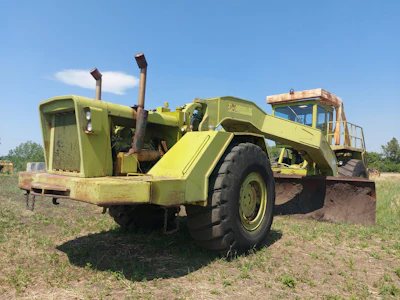
Alex Burnett’s reaction to the RayGo Giant was like most people’s first impressions of the massive motor grader that at one time was the largest in the world.
“I have never seen anything like that before,” he recalls thinking.
“If you're used to modern equipment,” he says, “this thing seems like the most wild-idea machine you've ever seen. It's not what you'd think of a traditional grader.”
That’s from someone who’s no stranger to construction and mining equipment.
Burnett is a former equipment trainer for a mining company and is now a manager for a residential excavation firm. About 10 years ago, he got interested in vintage construction equipment and joined the Heavy Construction Heritage Society in Alberta, Canada. As a volunteer, he keeps the museum’s RayGo Giant going for visitors and to preserve history.
“It's kind of a cross between running a large dozer and a large grader at the same time,” he says. “You basically take everything you know about running a grader and throw it out the window.”
(Check out the video at the end of this story to see it in action.)
Just What is the RayGo Giant?
 “Two scrapers with a funky neck built and a blade in the middle.”Heavy Construction Heritage Society
 Powered by
Burnett describes it as “just two scrapers with a funky neck built and a blade in the middle.”
The 53-ton Giant runs on twin 318-horsepower Detroit 8V71 diesel engines, one for the front axle and one for the back. It has a top speed of 22.5 mph.
Its 8,000-pound blade is 20 feet wide and can push as much in 7 hours as three traditional motor graders working 10 hours, according to an old sales brochure. It was twice as long as a standard motor grader then, at 46 feet. It stands 13 feet 10.5 inches high.
It was thought that only seven were produced and that the Heritage Society one that Burnett takes care of was the seventh, produced sometime between 1975 and 1977.


“We were under the impression for the longest time that ours was the last one built, but we found a few more,” he says. “… It sounds like about 18 were built. But there's not a lot of them left.”
 “You basically take everything you know about running a grader and throw it out the window.”Heavy Construction Heritage Society
“No two are the same,” Barrett says.
“There’re four different cabs on them. There was one that came with Cat engines. I've seen a couple now that have turbocharged Detroits in them — different exhaust configurations, different blade configurations.
“You can see where they found weaknesses in early machines and changed things, but it's not consistent.
“There's a large brace welded onto the side of our machine from the factory to keep the neck from cracking. But there are machines built after ours that don't have it for some reason.”
“It’s Slow. But It’s Cool. It’s loud.”
 Loud, slow and cool!Heavy Construction Heritage Society
“It doesn't do anything really quite like you'd expect it to,” Barrett says. “It's just very large and bulky. It's slow.
“But it's cool. It's loud.”
It also pushes huge amounts of dirt with little effort.
“The Giant can kind of be overwhelming as a grader,” Barrett explains. “You put the blade on the ground, and you go into a push. … You might even be taking a 9-inch cut for the full 20 feet of the blade, and it hardly notices.”
Maneuvering the Giant also takes some getting used to.
“So this thing, the blade itself doesn't angle like a traditional grader,” Barrett says. “You actually angle the machine around it to manipulate the blade the way you want it.”
Odd Machine Finds a Home
 “It doesn't do anything really quite like you'd expect it to.” Heavy Construction Heritage Society
It hadn’t run in about 10 years when the society’s next generation of vintage-machine enthusiasts decided to crank it back up.
“We spent fair part of a morning going through the two Detroits just making sure everything was free,” Barrett says. “It fired right up. We figured it was going to be a weekend of work, and I think it maybe took two and a half hours.”
The only other work has been replacing some hydraulic lines that had dry rot and the usual preventive maintenance for a 50-year-old motor grader.
Barrett suspects the Giant never really caught on because it was too big for the times. Its main function was leveling large piles and is not geared for fine grading.
“They're odd machines,” Barrett says. “They have very few uses outside of really large construction projects, and I think it was probably too big for the time. They just didn't find a great home.”
But fortunately for this Giant, it has found a great home, at the Heavy Construction Heritage Society where people can come see it and watch it run.
Watch It in Action
Check out the video below from the Heavy Construction Heritage Society as its RayGo Giant gets started after sitting idle for 10 years and then does what it does best, move lots of dirt: