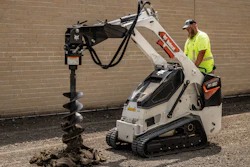











Bobcat’s next-generation skid steers and compact track loaders come in two varieties: Classic or Pro.
Scott Johnson, Bobcat senior director of product for construction equipment, comes on The Dirt to explain the differences between the two and to help you determine which is better for your jobsites.
The Classic models are the next generation of the M Series, with the tried-and-true basic Bobcat performance without the added tech and advanced features.
The Pro models are the next level in skid steer and CTL advancement, offering a variety of technology, including AI voice command, to make operators as efficient as possible, as well as help new ones get up to speed.
Called Jobsite Companion, operators can skip the scanning through display menus and simply tell the loader what they want, saving time and increasing productivity.
“That’s game changing,” says host and professional operator Bryan Furnace. “That’s exciting.”
New features on the Pros include four distinct operating modes, additional lift height and horsepower on the two largest models, and an updated cab that includes such conveniences as a phone holder and more storage.
So to get the lowdown on Bobcat’s next-gen skid steers and compact track loaders, check out the latest episode of The Dirt.
 Powered by
Equipment World serves up weekly videos on the latest in construction equipment, work trucks and pickup trucks — everything contractors need to get their work done. Subscribe and visit us at equipmentworld.com!
In This Video:
00:00 - Bobcat Classic & Pro CTLs and Skid Steers
00:19 - Classic & Pro Explained
02:34 - Pro Lineup Drive Modes
08:27 - Additional Pro Lineup Improvements
13:00 - AI Job Tracking
16:28 - AI Settings Optimization and Control
19:42 - How AI Assists Operators
00;00;00;01 - 00;00;19;06
Bryan Furnace
Hi everybody. Welcome back to Equipment World. You are watching The dirt and after a long hiatus, we are back. And today we're talking about Bobcat Bobcats bringing some exciting new features to their machines. And joining us today from Bobcat is Scott. He's going to break it down for us. So let's get into it.
00;00;19;08 - 00;00;39;16
Scott Johnson
Bobcat has made the decision to kind of move forward with two kind of named product lines. We have our classic formerly the R and the M we had. Right. And that was confusing because we have a lot of models. So what we've done is we've updated into two different lines the classic and a Pro, and we've upgraded some of the features we'll talk about today as well.
00;00;39;16 - 00;01;03;22
Scott Johnson
But really the classic products are the former M products. Those had some upgrades, but also really those for the customers that really just want to, you know, get the job done right. They don't need all the technology. They want the classic bobcat experience, the controllability. And so we want to clarify that for our customers and really go into making it easier to decide which paths should I go down the classic path where I just get the job done?
00;01;03;22 - 00;01;16;11
Scott Johnson
I don't need a lot of technology and pro where it's about, how do I take that job and get it done faster and more efficiently. That's really the difference between the two. But they're all one big evolution product launch.
00;01;16;13 - 00;01;28;25
Bryan Furnace
So just so I understand it correctly. And just to clarify a bit more on the classic lineup, are we still talking about open and closed cab options, high flow, low flow options, all of that stuff?
00;01;28;27 - 00;01;47;11
Scott Johnson
Yeah that and of course the standard hand foot controls that we've always had a lot of customers still buy those. So none of that's really changed. The biggest change on the classic was that we have in one of the packages. Now. We put an integrated rear camera into that. In the past it was an aftermarket product, so now it's integrated into that.
00;01;47;11 - 00;01;57;01
Scott Johnson
But it's the same classic type bobcat. We've always had all the same options as you mentioned, open cab, high flow options and so on as well as the integrated camera.
00;01;57;03 - 00;02;11;27
Bryan Furnace
So because we all know that there are the old school guys that just love their tried and true machines, what we're saying is from this point forward, if you want your old classic bobcat, you're going to go down the classic model line as opposed to the Pro Series.
00;02;11;29 - 00;02;33;04
Scott Johnson
Yep. That's right. And I think in the past people are wondering, well, is one series going away or not? At the end of the day, the the answer is no. We're going to have a pro and a classic. We're going to continue along that and support those products and then and grow them and evolve them over time. But really, the classic is really focused on I want a value machine that gets the job done, and I don't need all of the bells and whistles, if you will.
00;02;33;09 - 00;02;44;06
Bryan Furnace
Sure. So that being said, since we're all familiar with the classic bobcat machines, let's go down that pro lineup. Where does the Pro lineup start to pull away and differentiate itself?
00;02;44;09 - 00;03;06;05
Scott Johnson
You know, as we step back and we started to ask that question, what we really wanted to do was say, okay, so a lot of operators and owners are trying to do more with less people, right? There's a lot of turnover. Also newer, newer operators as people have been retiring. The question that we asked was how can we make it so that the machine really starts to adapt to those operators?
00;03;06;05 - 00;03;24;23
Scott Johnson
How can we make an operator more efficient in the same machine versus others? And in this case, I'll give you an example. One of the main features that we've really worked on really hard was we offer now four different drive modes, kind of like your car, right? We have eco mode, we have sport mode, and everyone's a little different.
00;03;24;24 - 00;03;49;11
Scott Johnson
It's quite a bit different. And it depends on your environment and your job in the case of your automobile. But we did the same thing with our pro. We have four different modes and they are balanced, agile, dynamic and charged. And they're all very different in how they accelerate and how they handle in those drive modes. And what we want to do is have the operator get in and find the one that's best suited for them or their job.
00;03;49;11 - 00;04;07;23
Scott Johnson
And maybe you have 2 or 3 people working for you, and they're all a little different. How can we make it so that they eat in the machine, and the machine helps them optimize their performance for the owner and operator? And if we can do that and we can separate that, the proline starts to allow us to adapt the machine to the operator.
00;04;07;23 - 00;04;24;15
Scott Johnson
Instead of asking an operator to spend many, many hours in the machine adapting to that. And if you can do that, you get more done in the same amount of time. And that's where across the board, the Pro line is really focused on, on doing that more and more starting now and then, of course, into the future.
00;04;24;18 - 00;04;42;06
Bryan Furnace
So I would even take that a step further as an operator. There's a lot of times where I may be in kind of a delicate situation up against a building, and I don't want to have that rapid response of the machines drives because I don't want to accidentally hit the building. And so to be able to, on the fly, flip over to a softer curve.
00;04;42;08 - 00;04;53;20
Bryan Furnace
And just so that to kind of further clarify, we're talking about the drives themselves. We're not talking about the hydraulics. Those would be adjusted independent of the drive mode. Correct?
00;04;53;23 - 00;05;22;15
Scott Johnson
Yeah. That's correct. So there in the previous machines we had a drive response and a workgroup response. Right. And you could do one, two, three. And they're very subtle differences between those drive responses. Now we're making them much more defined. And those are the drives as you just mentioned. Hydraulic is still the one two, three in terms of its responsiveness in the hydraulics, one being less so, two being standard and three being very responsive, like person in a workgroup response might want to do a lot of bucket shaking.
00;05;22;18 - 00;05;40;29
Scott Johnson
Workgroup response three is perfect for that, right? So it's the it's the job you're doing sometimes this specifically we're talking about the drive modes and how the you said it earlier the curve if you will. How does the machine accelerate. Is it real quick. Is it a smoother acceleration. Is it rapid? Each of the modes is pretty different.
00;05;40;29 - 00;05;59;27
Scott Johnson
And what we're finding with a lot of customer feedback is it really does depend on the job you're doing. Right. So the one that's the least responsive is called balanced. It's on of the four. And it's really made for those. Number one, if you've got a newer operator that doesn't need this thing you know they don't. They're not used to feathering the machine as much.
00;06;00;03 - 00;06;22;10
Scott Johnson
And you know, understanding the joystick. So basically it allows that. But also even for experienced operators, if I'm in a tight environment and like you said, I want to make sure I know exactly how that's operating and don't want to hit a building or something. That balanced mode allows you to work in that environment in a little more uncontrolled way, whereas charged, which is on the opposite side, is very quick and very responsive.
00;06;22;10 - 00;06;42;06
Scott Johnson
And if you're just going in and you're moving a pile from here to there and you're back and forth and you're very experienced. Operator. What we're finding is experienced operators, a lot of the time, like that charge mode, it's real quick, really responsive. They've got tons of hours of experience. And so everybody seems to be a little different like we've been we've probably seen a very even distribution of what people end up liking.
00;06;42;11 - 00;06;59;08
Scott Johnson
And then they do change it, as you mentioned in particular, to the job. It's been a very good new roll out with evolution and had very good positive response because of the fact. Again, we're helping adapt the machine more to the operator rather than trying to just wedge everybody into the same spot. Right. To everybody learn the same stuff.
00;06;59;10 - 00;07;20;07
Bryan Furnace
Yeah. And so that's where I, you know, with more and more in so many of my videos, I've started to tell operators, get into the menus, change things, because there's so many features that are going to make your life easier or more comfortable. If you just take a couple of minutes to get into the menu and change it, and that's this drive motor is exactly kind of where I go mentally is there might be times where I really need to hustle material across the job site.
00;07;20;08 - 00;07;47;24
Bryan Furnace
Absolutely. That charge mode is going to be fantastic for me. It's going to get me, it's going to get me there quick. But there's other days where I just have to shuffle a bunch of material and it's over a bumpy job site. I don't necessarily want to have the jerkiness of slowing down for those bumps, but it's still jerking up against the controls instead, to be able to maybe go over to that balanced mode and get a little bit of a smoothness so that it's not so hard on my body through the day that that man, I could see that being so convenient.
00;07;47;26 - 00;08;04;26
Scott Johnson
Yeah. And it's real quick, you know, when we when you go into the menus here, right below each of those modes, they actually gives us a little bar about different things like smoothness, acceleration. Those are two of the three. And it actually shows you right below it. So what happens is the first time you go in there you can see what to expect.
00;08;05;02 - 00;08;21;09
Scott Johnson
Then you can test it. And then once you figure that out, you'll know in the future which one, in which situation you want to, you want to move to. And yeah, that's exactly right. I mean, that's just one of the main things that we've, in essence changed here is we moved into this evolved pro and classic line, especially in the Pro lineup.
00;08;21;09 - 00;08;26;02
Scott Johnson
This this is one of the main three, 4 or 5 things that we've done with that lineup in this launch.
00;08;26;08 - 00;08;38;27
Bryan Furnace
Yeah. So going forward, another feature that really differentiates the pro lineup outside of those drive modes. But before we get into that, I want to take a second to tell you about the sponsor of this video, Chevron Lubricants.
00;08;39;03 - 00;09;05;04
Speaker 3
When you are the foundation, everything gets built on, not getting the job done is not an option. Your choice of diesel engine oil can make or break your ability to perform. Keep equipment on the job with the only ultra low ash, heavy duty engine oil that reduces clogging to extend DPF light, increases drain intervals and improves fuel economy when it's on the line.
00;09;05;09 - 00;09;08;28
Speaker 3
Shoe. Chevron Delo 680 F.
00;09;09;00 - 00;09;15;25
Bryan Furnace
Yeah. So going forward, what's another feature that really differentiates the Pro lineup outside of those drive modes?
00;09;15;27 - 00;09;41;03
Scott Johnson
We really focused on four things improvements on performance and quality. And when I say that, I think the all of the products in our Pro, so it's the 66, the 76th and 86 have had weight reduction. So there's a much more agile feel to each one of them. They've had weight reductions keeping the same horsepower. But probably the biggest performance game is in the 86, both the S and T 86, where we have now added a 12ft lift height.
00;09;41;04 - 00;10;01;01
Scott Johnson
It was 11ft. And so now that's 12, which is the first and only in its class to hit the 12ft lift height. And we increased the horsepower to 115 horsepower. So big performance gains a big deal on the lift. Right? Right. And then you add in the controllability and it becomes kind of everything into that one package. Each of the others have that as well.
00;10;01;04 - 00;10;16;13
Scott Johnson
Then we also really updated the interior of our machines. The look overall inside has changed, but there's two big things we've added that seem small but are bigger. One is a phone holder. More and more, I think there's an expectation of a phone holder and a machine. So we've added that.
00;10;16;15 - 00;10;24;03
Bryan Furnace
It's nice to have something to hold your phone and it's not. I had to use a magnet mount on my phone to slap it up against the cab, because no one has phone holders.
00;10;24;09 - 00;10;41;12
Scott Johnson
Yeah. And, you know, obviously it's just it's become kind of it's better than putting somewhere that falls out on you. So that's number one. And the number two we ended up to the right below your knee. There's a big storage area. It's like 12 or 13in long. And again storage and space in the machine is always at a premium.
00;10;41;13 - 00;11;00;16
Scott Johnson
So now there's a place to put your gloves or whatever it may be. And again small but really in my opinion important. And then last on the inside we've updated on the Pro. All of the displays are now eight inch touch displays in that in that machine. So there's a traumatically different look and feel to that, to the display itself in all of those machines.
00;11;00;20 - 00;11;16;09
Scott Johnson
And that brings us kind of into the last two things that we really changed with these. One of them is is really about job site awareness. We have now we've added the ability as an option to have 270 cameras. So with the fact that we now have an eight inch display, you have the ability to see more, right?
00;11;16;09 - 00;11;27;09
Scott Johnson
So you still can see what's behind you in your in your screen for the reverse camera. But now you can also see alongside the tracks when you have 270 and the screen is big enough to allow you to actually see that and utilize that.
00;11;27;10 - 00;11;28;01
Bryan Furnace
Excellent.
00;11;28;02 - 00;11;52;24
Scott Johnson
That was a big change. And then we launched something called Bobcat Sense, which is a radar system that will actually alert you to objects behind you and also derail the machine as you approach that object. So if you're working in an area where you cannot hit something that's absolutely critical, you will actually rate the middle, alert you audibly, but also direct the machine and actually makes it impossible to to back into it.
00;11;52;25 - 00;11;53;14
Bryan Furnace
Wow.
00;11;53;17 - 00;12;15;22
Scott Johnson
But yeah, so that's a big advancement as well. And those are really about awareness on the site. We have some customers where look I want to make sure whatever happens behind me I don't hit that. And you can turn it on and off and there's others is, hey, I want to be able to see 270 along those tracks, because getting on in a, in a tight area like you talked about or getting on and off trailers, that does help and it makes you more efficient as well.
00;12;15;23 - 00;12;43;22
Scott Johnson
Again, remember, the whole point of the Pro is to help operators be more efficient with their time. And then last week we integrated really an intelligence feature, indoor machines, which we'll talk more about. And that is we took AI. Sounds scary, but what we've done is we've taken elements of AI and really combined them with the ability to create efficiency opportunities for operators and owners to make, to basically make more money, which attract their costing.
00;12;43;22 - 00;12;59;28
Scott Johnson
And really, when you do that, we're not bringing AI to do anything like control the machine. We're bringing AI in essence, to make the operator have more information to be more efficient in their job. That's that's our goal. And so we've added that in and that's in all of our Pro line at an advanced package.
00;13;00;02 - 00;13;19;25
Bryan Furnace
Okay. This is where I get to play the old school. Everybody knows them. Operator what in God's name do I need AI on my machine for? Give me an example of of how this is being utilized because I immediately go to AI is investing everything and it's not needed in everything. So how is this helping us on the job?
00;13;20;01 - 00;13;53;14
Scott Johnson
Yeah, that is absolutely critical. So there's there's two points that first of all, we we completely understand it. Do we think this isn't for everyone right. This the world is changing quickly. We have a classic line for a reason. Right. There is the reason we kept that around. Because there are a lot of people and, you know, a lot of operators, including here, who just say, hey, look, I'm I'm comfortable with what we have, but if we're going to actually give opportunity in the Pro line to make people, operators and owners more money and more efficient, we have to utilize the technology that's really kind of on the cutting edge.
00;13;53;14 - 00;14;19;09
Scott Johnson
And so what bobcat has done is we've embedded this onto our machine and it really does two things. It has the ability with voice to guide you through operations. But that's not the key point. We have a couple of major things that you see when you look at the screen. What we've learned is that if you have an operator and their expectation is to do a job and let's say eight hours, right, and as an owner and that or an operator, you know, that's your goal.
00;14;19;11 - 00;14;38;25
Scott Johnson
We've taken that and we've put that goal on to the main screen. And then we actually have let you know where you're at on in respect to that goal. So hey, I'm four hours in, for example. It'll actually show up our on the screen to show him four hours into an eight hour job. And it will actually calculate if you are a header behind schedule on that job.
00;14;38;25 - 00;15;03;00
Scott Johnson
So as an operator, you're going to be more efficient if you understand what your goal is and where you're at in relation to that goal. So we put that onto the screen and it'll actually say, okay, your goal is eight hours. If you continue on your current pace, you'll actually take 8.5 hours. And the reason this matters on the other side is as an owner, if you're quoting a job and you have, let's say you're doing a snow workshop, I'll just use an example.
00;15;03;01 - 00;15;23;21
Scott Johnson
Right? We're coming into snow season sometime soon or brush works. You have a machine out there and you quoted the job at $5,000. Well, if that was supposed to be done in eight hours and you're on track to do it in nine, then you'll actually be able to see in our machine now how much the quote was and how much you expected it to cost and what you're actually on track to do.
00;15;23;21 - 00;15;47;15
Scott Johnson
So is it going to cost you $6,000 instead of $5,000? It's a huge opportunity for owners then to understand, okay, in the future, when I quote this type of job, should I be quoting more or less? Can I can I be more competitive, or do I need to cover those costs in a different way? And what we want to do for both owners and operators is help them be the most efficient and have the most opportunity to make the the money in their job.
00;15;47;15 - 00;16;10;20
Scott Johnson
And again, adapting the machine to both of those is our way of helping owners and operators and our systems that we have in this machine literally guide you through that. And then we take all of the information from the machine, and we put it through our owner portal with through our telematics, so an owner can go back at the end of the day or even every 20 minutes and actually literally see where they're at on a job cost wise, live if they want.
00;16;10;21 - 00;16;25;28
Scott Johnson
It's every 20 minutes or so that it updates, but you could see it at the end of the day or at the end of a job, and you can make adjustments in the future for both the owner of the operator to be more efficient. So we bring efficiency into the machine. We bring understanding of cost into the machine as well.
00;16;26;01 - 00;16;48;13
Scott Johnson
Those are two of the biggest features. And then the last one that we really introduced with this is the settings. You mentioned earlier that a lot of operators don't make the adjustments to that. They could do the machine to be more efficient. So one of the things that they get used to is they set the machine settings, and then they have different attachments, and they kind of leave the settings pretty much the way they were, and then they just adapt to that.
00;16;48;14 - 00;17;08;19
Scott Johnson
So now with the system, it actually takes your attachment and it customizes the machine settings to the attachment that you have. And with AKR and high flow attachments it does that now. But now it goes to all of the catchments, not just any type of attachment. And it shows you on the screen. Okay, these are the suggested settings for that attachment and the job you're doing.
00;17;08;22 - 00;17;27;14
Scott Johnson
Do you want to turn them on. And then if the answer is yes, it'll actually change all those settings for you without having to go through menus and settings. It basically adapts that machine to the job you're doing and the right settings to make you more efficient in your operation. So we've really tried to focus this solely on how do we help operators be more efficient?
00;17;27;19 - 00;17;38;28
Scott Johnson
Owners make more money. This isn't about doing machine operations for you or anything like that. It's not that type of AI. It is an AI that is solely taking the computer power and helping people be more efficient with their job.
00;17;38;29 - 00;17;51;28
Bryan Furnace
So if I'm understanding this correctly, for instance, if I'm in the machine, can I say, hey, bobcat, or whatever the initiating phrase is, turn my drives to balanced mode and it's going to switch those over?
00;17;52;00 - 00;18;10;04
Scott Johnson
Yep. It will. So the attachments is one thing, but the but the drive modes that you brought up just now and that we talked about earlier. Yes. You could just say turn on instead of going through 2 or 3 settings on the on the display, you could just say turn on balanced, you know, or, and, or you could say turn on charged mode.
00;18;10;04 - 00;18;22;25
Scott Johnson
And it would change it and it shows on the screen what it changed so that you don't have to remember which mode you're in. Right? It'll just it'll actually literally highlight it, show you that it changed it. So you know which active mode you're in and in all the other settings that you might change.
00;18;22;27 - 00;18;40;13
Bryan Furnace
So I guess what are my limitations on settings? So where I go mentally is if I'm pulling up to a building and I need to get into a finesse mode on the fly, could I say, hey, turn my drives to balance mode, set my hydraulics for my bucket down to five? Or am I allowed to tweak these things on the fly?
00;18;40;13 - 00;18;43;17
Bryan Furnace
And can you get into that level of depth with this tool?
00;18;43;20 - 00;19;03;27
Scott Johnson
Yeah, any of the settings in the machine, you can actually just ask. So to the to your examples. Right. You can change your drive mode. We talked about if you want to change, let's say you're doing a lot of work all of a sudden where you want to do some bucket shaking. You can move your workgroup response from one, let's say you had it in 1 to 3 just by saying change it workgroup response to three, and it would change it.
00;19;04;01 - 00;19;20;19
Scott Johnson
And it shows you on the screen any of those type of settings. But again, as you move in, as soon as you hit our Bobcats down, it'll actually prompt you which detachment it is. And when you do that, it'll bring up the suggested settings. And just so you know, to you could customize all of the attachment settings to what you prefer.
00;19;20;22 - 00;19;35;00
Scott Johnson
And then when it, when you bring that attachment online, let's say it's a planner, the next time it will bring your settings forward and say do you want to turn them on? And the answer is yes. You'll turn them on all for you. And then you don't have to say each time which 3 or 4 you want to change.
00;19;35;00 - 00;19;41;21
Scott Johnson
You can customize it to your job and your attachment without having to actually ask for each one of the 3 or 4.
00;19;41;23 - 00;20;00;05
Bryan Furnace
Yeah, where I go mentally. So so don't get me wrong, everything about the, the, the job tracking and everything from an ownership standpoint is exciting. I can see a lot of value there. From a purely operational standpoint, I actually get more excited about this AI tool because there are so many features in the drive modes is a great example.
00;20;00;05 - 00;20;35;23
Bryan Furnace
There are so many features that we as operators just don't utilize. This really excites me because it allows us to keep our efficiency. But now we can start to dial that machine even more to our liking. Not just overall, but down to the finesse level of what we're doing in that situation. Hey, turn that speed up because I need to zip across the site, and once you get to the other side, hey, put me down into the into the slower speed and slow my bucket hydraulics down to be able to have that level of adjustability on the fly, that's game changing as an operator, that's exciting.
00;20;35;29 - 00;20;51;09
Scott Johnson
Yeah. Well, you know, you gave a great example. A lot of people in different attachments will use speed management. Right. And we'll have speed management at let's say 35 or whatever it may be when you move out of one speed into speed management. Because okay, now I need to use a planer or whatever it may be, and it'll be on 35.
00;20;51;11 - 00;21;05;27
Scott Johnson
But sometimes you want to speed that up or slow it down. And right now you know, you have to actually scroll through the numbers. Now you can just ask it. So if you can just say change speed management to ten, it'll automatically do it. You don't have to take your hands off the controls, and you don't have to sit there and scroll or pause your work.
00;21;05;28 - 00;21;18;00
Scott Johnson
So we want to bring it forward in a way that's so easy to use and really one touch or one command, rather than going into the settings and changing 4 or 5 things and then guessing, right. We're trying to move away from that as well.
00;21;18;06 - 00;21;37;16
Bryan Furnace
Yeah, that's super exciting. And to be honest, that's what's so exciting about the time that we're in. Just just overall with equipment is for the longest time it was everyone was focusing on getting through emissions. And that's what all of the improvements to machines were, were emissions. And then we moved to okay, now it was time to upgrade some horsepower and everything.
00;21;37;17 - 00;21;57;12
Bryan Furnace
I feel like for the first time in a very long time, we're starting to see real innovation. And that's that's where I go with this is this is such an innovative idea. It's something that is now taking me as an operator and making me that much more efficient, but also giving me an additional level of comfort so that I can be more efficient because I'm not breaking my body as I'm doing it.
00;21;57;12 - 00;22;00;14
Bryan Furnace
So super excited to get in the seat of one of these.
00;22;00;17 - 00;22;19;17
Scott Johnson
Well, yeah, we'd love to get you in other people again. Getting in it and feeling it and seeing it is always, you know, our what we would like people to do because it's easy to talk about it. It's easy to say it, but seeing it feeling and touching it matter a lot. We've had a lot of people in these machines over the last, even the last four weeks, especially in the intelligence piece of it.
00;22;19;17 - 00;22;38;13
Scott Johnson
And what we're finding is exactly that. It's there surprised at how okay, this is intuitive, right? It I have an attachment. It sets my settings. Great. I can just move and do it. Now if I want to change some of the future okay, fine, I change it. But again our goal is making this simple, not overcomplicating and not doing too much right.
00;22;38;14 - 00;22;53;25
Scott Johnson
This is still a machine that needs to get a job done, and our goal is to enable that. And this technology, you know, one of the things I get asked a lot is, okay, what happens if this technology breaks? What about my machine? Well, the good news is nothing is dependent on this. So for some reason this technology stops working.
00;22;54;00 - 00;23;09;21
Scott Johnson
We haven't had that problem. But if it did, the machine continues to be operated the way it always has. You know, to often people. Right. With new technology. Oh it might break. And then I got to bring it in, you know, and the goal of this is not to have that happen. You can keep working just as you always would have.
00;23;09;21 - 00;23;22;25
Scott Johnson
And again, I don't we've not had that issue, but I haven't had that question a couple of times because people at the end of the day, operators need to keep working regardless of what happens. And we want to make sure that we, number one, make them more efficient. But if something ever does go wrong, how do we keep them working?
00;23;22;28 - 00;23;30;11
Bryan Furnace
Absolutely. Well, Scott, thank you so much for coming on the show. Thank you for discussing all this. Like I said, I'm very excited to see one of these on the job.
00;23;30;13 - 00;23;33;08
Scott Johnson
Well, thanks a lot. Brian, I really appreciate the time.
00;23;33;11 - 00;23;49;08
Bryan Furnace
Well, thank you again for Scott coming on the show to talk to us about some of the new features coming on the bobcat CT. LS it's an exciting time in the equipment space. There's lots of innovations happening and I can't wait to get in these machines on the job site. So as always, I hope this helps you in your business.
00;23;49;11 - 00;23;51;14
Bryan Furnace
We'll catch you on the next episode of The Dirt.