











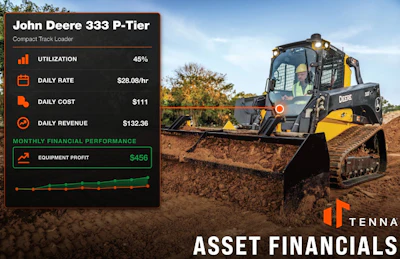
Tenna says its new telematics-powered job costing and internal billing software, Asset Financials, helps contractors answer the age-old question: “how much did that piece of equipment actually cost or earn on that job?”
Using the live operational data already flowing through Tenna's mixed-fleet equipment operations and asset tracking software, Asset Financials determines in real time whether each asset — from equipment, to vehicles, to tools and more — is earning its keep by job, by period and in aggregate.
Here’s how it works:
- Asset Financials collects real-time telematics data from each asset in the fleet, including engine hours, location, movement, utilization status and operational state.
- Geofencing automatically links equipment activity to specific jobs. When a machine enters a job’s geofence, the system registers the assignment and begins tracking costs. When it moves to a new job, the previous assignment closes and the new one opens, with no manual entry required. Each asset automatically self-reports on where it was and how long it worked.
- Billing, costing and charging rules based on asset class, utilization status, job type, department, or any combination are established to provide revenue attribution by asset.
- Costs are automatically calculated and assigned to the correct job and cost code based on machine activity, providing a holistic view of asset costs, not just the operating rate.
- Clean, structured equipment cost data can then be pushed into an ERP to provide accurate job cost reports.
Asset Financials produces a variety of reports to ensure the shop, field and financial teams are working from the same machine data, including:
- Real-time asset P&L: An asset-level profit and loss view per machine, built from the cost and revenue that flow from actual machine activity, updated continuously as operational data comes in.
- Automated job costing: Equipment costs allocated to specific jobs and cost codes based on actual activity from the machine, not estimates or operator reports.
- Internal billing records: Defensible internal charge documentation grounded in telematics data.
- Fleet-level profitability benchmarks: Aggregated asset P&L data by equipment and asset class provides the financial basis for future purchase, rental, redeployment, and replacement decisions.
- ERP-ready output: Financial data formatted for existing accounting systems with the operational context needed to stay accurate.
Because equipment job costing and charging varies significantly across contractors by asset class, project type, contract structure and internal accounting practice, Asset Financials does not impose a standardized rate model. Rather, it provides a configurable rule engine that automates whatever rate logic the contractor already uses.
Rates can be configured at the account level as organization-wide templates or at the job level to accommodate specific contract requirements and project-specific conditions, giving finance teams consistency and control while providing field teams with flexibility.
 Powered by
“If you can explain your rate logic today, we can automate it,” said William Hipp, product analyst at Tenna. “Every contractor thinks their billing structure is uniquely complex, and they’re usually right. We built Asset Financials to support the model already in place, not to replace it with something generic.”
The rate engine supports differentiated logic for working, idle, and standby status; asset class and job-specific overrides; and production-based workflows, automatically applying the right rate to the right machine in the right context, without manual recalculation, Tenna says. If the machine has unplanned downtime, rate exceptions can be applied to prevent the job from being over charged.
“Contractors now have a system that uses what their machines and other owned assets actually do to drive what gets charged and costed to a job, and how,” said Austin Conti, co-founder and CEO of Tenna. “The data has always been there. Asset Financials puts it to work.”


Asset Financials is not an ERP and is not designed to replace one, Tenna says. It serves as an operational layer, providing the equipment data needed to produce accurate job reports, without changing existing accounting systems or financial workflows.
John Deere acquired Tenna in February, expanding its mixed fleet management and digital workflow capabilities. Tenna continues to operate as an independent business. Asset Financials is available now.