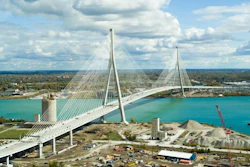












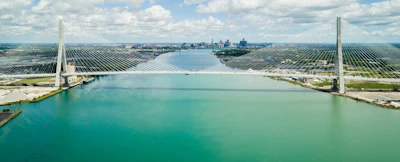
Only a few days after the two countries struck a new deal and scheduled the long-awaited opening of the six-lane, cable-stayed Gordie Howe Bridge, new tariffs on Canada from the Trump administration have killed a planned joint celebration.
In an emailed statement to Reuters, Jenna Ghassabeh, a spokesperson for Canadian Infrastructure Minister Gregor Robertson, said, “In light of trade action threatened by the United States earlier this week, it would be inappropriate to proceed with a celebratory event between the two countries.” Ghassabeh added that Canada is still committed to the July 27 opening date but would only be celebrating “among Canadians.”
The tariffs were announced July 20. A White House press release cites Section 338 of the Tariff Act of 1930 as the reason for adding 50% tariffs on certain Canadian goods to “offset the burden and disadvantage on U.S. commerce from Canada’s discriminatory treat of U.S. commerce.”
A wide variety of goods will be hit by the new tariffs, including cement, alcohol, cars, dairy, even hockey sticks. The new tariffs will apply even if the products originate under the U.S.-Mexico-Canada Agreement.
Months of Struggle Prior to Opening
The Canadian government announced the Gordie Howe Bridge’s new opening date of July 27 on July 10, heralding the structure as a new hub of economic growth and trade for both countries.
 Powered by
Canada also stated at the time that, to “ensure that benefits are felt on both sides of the border,” the two countries agreed on several new cooperative measures regarding toll governance and transparency. This includes establishing a 15-year economic development fund tied to a portion of the revenue from the bridge’s operations.
The U.S. government will also now have a say in toll-rate adjustments, per a new collaborative work plan with the Windsor-Detroit Bridge Authority, the entity created to manage the Gordie Howe Bridge.
U.S. Secretary of Commerce Howard Lutnik, in a July 18 post on X, stated the U.S. will now receive 50% of the bridge's net revenue until 2041. Canadian Prime Minister Mark Carney said the same during a press briefing July 16, according to Reuters, but added that Canada would not share toll revenue with the U.S. until it had fully recouped the building cost of the bridge, in line with the original 2012 agreement between Canada and Michigan.


The opening announcement follows several months of political head-butting between Canada and the U.S., after Trump threatened to block the bridge’s opening in February over what he called unfair treatment of the U.S. by Canada.
Once open, the Gordie Howe International Bridge will be the first new connection between Windsor and Detroit in more than 60 years. It measures 1.56 miles long, is the longest cable-stayed bridge in North America and the 10th longest in the world. The bridge towers, completed in 2024, stand 722 feet tall.
Originally estimated to cost $2.1 billion and be completed in 2020, the Federal Highway Administration puts the total cost of the bridge’s contracts at roughly $5.2 billion. Ground was broken on the Gordie Howe Bridge in October 2018.
The project’s contract went to Bridging North America, a consortium of ACS Infrastructure Canada, Dragados Canada, Fluor Canada, AECOM and Aecon Group.