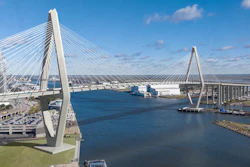












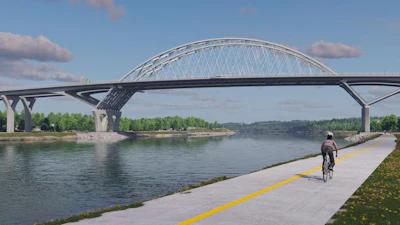
The Massachusetts Department of Transportation is one step closer to completing the future $2.1 billion Sagamore Bridge after Governor Maura Healey’s office released the latest project renderings.
The renderings of the future structure, which will replace the 90-year-old Cape Cod Bridges in southeast Massachusetts, reveal new separate bridge spans for improved safety, a barrier-separated shared-use path, upgraded roadway connections and new architectural features.
To see the new MassDOT renderings, scroll to the end of this article.
Earlier this year, MassDOT released the project’s replacement schedule, which will see the notice for construction to proceed on the 1,400-foot-long Sagamore Bridge issued around Winter 2027 and construction starting the following spring. The southbound bridge span is scheduled to float in around Fall 2031, and the current bridge will be demolished in Winter 2033. Traffic is expected to open on the new bridge in 2033, and all work on the estimated $2.1 billion project is expected to finish by 2036.
The Sagamore Bridge and its southern counterpart, the 2,400-foot-long Bourne Bridge, are the main access between the Cape Cod peninsula and mainland. The Bourne Bridge is also set for full replacement as part of the state’s $4.5 billion Cape Cod Bridges project.

 Powered by
Both bridges, which each carry four lanes of traffic, are characterized by MassDOT as structurally deficient, functionally obsolete and close to the end of their usable life. Each will be replaced by an arched twin-bridge structure to improve safety and traffic operations, as well as allow construction to be completed in stages to avoid long-term lane closures.
Separating traffic in each direction to its own bridge will, according to MassDOT, reduce the risk of head-on and sideswipe crashes. Other improvements include wider lanes, left and right shoulders, updated signs and pavement markings, and an auxiliary lane for drivers entering from or exiting onto local roads.
The new bridges will also address pedestrians and bicyclists with safer pathways, a new loop trail between the bridges, improved connections to local roads and multimodal trails, and barrier-separated shared-use paths.


Built in 1933, the steel-arch Sagamore and Bourne bridges replaced the two original electrically operated, cantilever highway bridges that provided the first crossings over the Cape Cod Canal after its opening in 1914.
Both bridges are currently owned and operated by the U.S. Army Corps of Engineers, but they will be under MassDOT control after they are replaced.
 Massachusetts DOT
 Massachusetts DOT
 Massachusetts DOT
 Massachusetts DOT
 Massachusetts DOT
 Massachusetts DOT