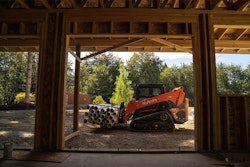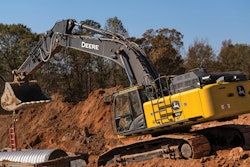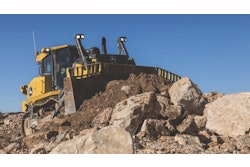













Collision warning and collision mitigation technologies will now come standard on the majority of new Caterpillar construction machines in 2027.
The move aims to expand access to and adoption of advanced safety technology across fleets, helping to improve operator awareness, jobsite safety and productivity, Cat says. Previously optional on select models and configurations, these technologies can help operators identify potential hazards and respond to changing conditions.
“Keeping employees safe on busy jobsites is a priority for our customers, and we’re committed to helping them,” said Rod Shurman, group president of Caterpillar’s Construction Industries. “Moving these technologies from optional to standard on eligible machines makes it easier to adopt consistently across jobsites and support safer operations today.”
To protect workers on busy jobsite, the systems can provide visual and audible alerts when hazards are detected and, in certain situations, initiate mitigation measures to help reduce the likelihood or severity of a collision.
Depending on machine configuration, here are some examples of the systems and how they work:
- Collision Warning System: Radar sensors provide the operator with monitoring behind the machine when in neutral or reverse, while audible and visual alerts help reduce the risk of collisions with static and moving objects. Warning levels change with ground speed to reduce “nuisance” alarms.
- Includes:
- People Detection: An intelligent vision system with 180-degree camera coverage that alerts an operator when someone enters within a machine’s hazard zone. Levels of alerts adjust based on a person’s proximity to the machine, and the system highlights people in red bounding boxes on the in-cab monitor to help operators more quickly manage potential risks.
- Object Detection: A two-part system providing enhanced blind-spot awareness. Radar provides visual and audible alerts when objects enter a safety proximity zone, while a camera allows the operator to see what's behind the machine when reversing.
- Includes:
- Collision Mitigation System: Builds off the Collision Warning Systems using an integrated and intelligent sensor array to provide reverse collision warnings, detect people, inhibit motion and enable automatic emergency braking. The system may not detect people in certain circumstances, such as people lying down or crouching, or when cameras are impaired by low light conditions, inclement weather or other similar conditions.
- Includes:
- Motion Inhibit: Works with Collision Warning and People Detection to provide extra safety behind stationary machines by automatically preventing direct reverse gear engagement if hazards are detected. If the operator goes back into neutral and the danger is gone, the machine can then reverse.
- Automatic Emergency Braking: A safety feature that automatically engages emergency brakes if a potential collision is detected and the operator fails to take evasive action. When the collision potential is no longer detected within the critical zone, machine control is returned to the operator.
- Includes:
Customers will also have access to VisionLink where they can review videos and insights across their fleet, see where close calls happen most often and coach operators to continuously improve.
 Powered by
“Safety around construction equipment is a fundamental priority for VINCI Construction. Making collision warning, pedestrian detection and mitigation technologies standard on new machines is an important step forward,” said Anthony Flandrin, equipment director for VINCI Construction. “It will help accelerate our deployment across fleets, provide operators with consistent access to awareness and support tools, and ultimately, help us reduce equipment-related incidents on our jobsites.”