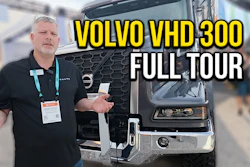












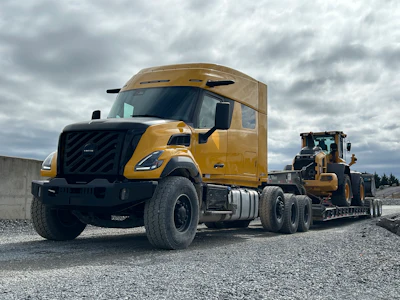
Built specifically for North American job sites, Volvo’s third-generation VNX combines rugged structural upgrades, a 540-hp 2027 engine, and driver-focused ergonomics to expand the brand's heavy-haul reach.
- Ambitious Market Growth: VTNA aims to triple its construction and heavy-haul market share from roughly 3% to 10% using the newly redesigned VNX platform.
- Cross-Divisional Expertise: The truck incorporates design and integration insights from Volvo Construction Equipment, streamlining equipment management, parts distribution, and financing.
- Job-Site Durability & Upfitting: Structural enhancements include a three-piece steel bumper, 40-ton-rated tow hooks, and clean frame rails designed to simplify post-factory bodybuilder assembly.
- Powerful 2027 Powertrain: Powered by an updated D13 engine delivering up to 540 horsepower and 1,950 lb-ft of torque, meeting 2027 emissions standards without regulatory credits.
Volvo Trucks North America on Wednesday unveiled a redesigned VNX heavy-haul and vocational truck, marking the manufacturer's third model refresh in 33 months.
VTNA currently holds a roughly 3% marketshare in construction and heavy-haul, but VTNA President Peter Voorhoeve said the company aims to capture roughly 10% with the VNX, building on a legacy that includes its long-haul success and previous vocational offerings like the VHD. While the earlier VHD built a loyal customer base, Voorhoeve noted its utility was limited.
"Now we are [broadening our reach] with a much wider application range with the all-new VNX," Voorhoeve said. "I do believe we can have a significantly stronger position. ... This truck is nothing like you’ve ever seen before from Volvo Trucks, with a rugged, all-business design built for the toughest jobs out there."
The company didn't have to look far for design expertise, tapping Volvo Construction Equipment, which has manufactured heavy machinery in the U.S. for more than 50 years.
"We are the only OEM in the world that has yellow machines and truck manufacturing in the same house," Voorhoeve said, adding this combination of expertise comes with a unique understanding of how work gets done on the job site.
 Powered by
That integration streamlines everything from buying equipment to maintaining it, Voorhoeve added. Spare parts distribution, warehouse networks, and service locations are shared across Volvo Construction Equipment, Volvo Trucks, and Volvo Penta operations, and Volvo’s global technology organization shares heavy-duty engine architecture and engineering requirements across both vocational truck platforms and off-road machinery. Volvo Financial Services handles financing for both construction and heavy-duty trucks, streamlining capital management for buyers.
A Driver's Truck
Volvo sells vocational models globally — including the FMX and VMX lines across Europe, Asia, Africa and Latin America — but Voorhoeve stressed that the new third-generation VNX is engineered specifically for the demands of a North American job site.


The VTNA design team targeted specific frustrations and day-to-day challenges faced by drivers in rough-terrain and off-road applications.
"We wanted to bring the voice of the customer into the studio," said Head of Design Brian Balicki. "So we always ask the question: How would the customer react to this, and how does this change make it better for them?"
Key structural upgrades include high tensile, heat-treated steel frame rails rated for 160,000 pounds GVW (with application approval available for higher ratings); a heavy-duty steel grille backed with a metal mesh that keeps debris from being kicked into the radiator from other equipment on the site; and a three-piece stamped metal bumper that supports tow hook options for the VNX. The frame-mounted hooks are rated up to 40 tons.
Volvo tailored the chassis and exterior packaging for bodybuilders, featuring clean frame rails with pre-drilled holes, a 29-pin connector, and flexible battery and air-tank locations.
The VNX is available in three cab configurations in either axle-forward or axle-back configurations:
- The VNX 300 daycab comes as a tractor or a straight truck.
- The VNX 440 gets a 42-inch sleeper and is available as a tractor or a straight truck.
- The tractor-only VNX 640 is equipped with a 62-inch mid-roof sleeper.
When designing the interior of the all-new VNX, Chief Designer Jason Dabel and Balicki said the team approached the project with a singular mission: to create a workspace that delivers "living room comfort" while standing up to the demanding realities of dirty and hard work.
Inside the cab, the team focused on premium touchpoints without sacrificing durability:
- The dash and trim: Cab options include a fathom blue dashboard developed alongside brushed satin metallic trim. The dash topper and integrated door armrests feature soft-touch, high-quality materials paired with a unique Gecko texture.
- Steering and seating: The steering wheel is leather-wrapped in edge black with matching black stitching. Meanwhile, specialized, modular floor mats feature an elevation pattern with deep grooves designed to easily trap mud, dirt, and snow.
- Customizable storage: The cab includes repositionable cupholders that can be moved along the engine cover without tools, or added and removed to give passengers extra legroom. Additionally, map pockets were redesigned at specific angles to prevent drivers from banging their elbows while bouncing over rough terrain.
To solve this, Volvo made controls heavily tactile, ensuring drivers can physically feel each detent and step when making adjustments. This design choice gives drivers the confidence that switches have engaged safely while keeping their eyes focused on the road.
The truck also features customizable switch banks. Fleet operators can physically move switches around, and the truck's electrical architecture automatically recognizes the feature assigned to that switch, allowing fleets to standardize layouts so drivers do not have to relearn controls when switching trucks.
Maintenance and troubleshooting were also made simpler:
- Tool-free fuse access: The entire passenger-side panel is completely removable without tools via a molded-in handle, providing instant access to fuses and the bodybuilder electrical center.
- Rear-cab access: A clean cab pass-through beneath the map pocket offers tidy wiring and switch control connections.
Safety
Ruggedness was important in the design process, but driver safety systems are central to the new VNX.
"These are the safest vocational trucks that we have ever built," said VTNA Product Marketing Manager John Moore, noting the new VNX also gets record-high marks for comfort and reduced cab noise.
To improve safety during low-light conditions, the truck features upgraded fog and cornering lights providing up to 80 degrees of ground projection. The backup cab lights and the cornering lights illuminate on the VNX's back end, creating the best possible view around any obstacle around the truck, Balicki noted.
"There's so much more that the VNX is doing to help drivers see better, steer better, and navigate more easily around a work site," he added.
To maximize downward visibility, designers carefully carved away parts of the dash trim, creating a signature look that directly improves line of sight.
Power
A new top-end rating for the 2027 D13 engine is 40 horsepower stronger than the prior generation thanks to a larger cooling package. It now tops out at 540 horsepower with 1,950 pound-feet of torque. That is paired with a 630-horsepower engine brake to take some of the slowing and stopping load off the service brakes.
Voorhoeve emphasized that Volvo's 2027 engine technology achieves emissions compliance without relying on regulatory credits. While the U.S. Environmental Protection Agency’s 2027 mandates offer compliance pathways via credits or nonconformance penalties for manufacturers still catching up, Voorhoeve said Volvo's hardware is fully prepared.
"We have compliant technology. We don't play with the rules," he said.
The driveline is anchored by Volvo's I-Shift automated manual transmission. Available in 12-, 13-, and 14-speed configurations with direct or overdrive options, the I-Shift is engineered to handle extreme payloads and severe job-site conditions and optimizes shift points, enhance low-speed maneuverability, and improve heavy-load handling on rough terrain.
The transmission incorporates heavy-duty features tailored for vocational use, including specialized drive modes (Economy+, Economy, and Performance), enhanced transmission PTO capabilities for auxiliary equipment, and automated grade and load sensors to ensure seamless power delivery under high gross combination weight (GCW) demands.