











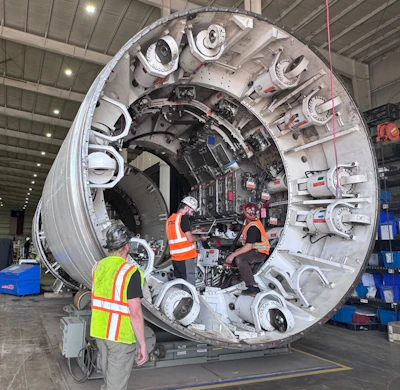
With its first two tunnel boring machines in action, Elon Musk’s The Boring Company has announced plans to launch a third TBM on its Nashville Music City Loop project, with a fourth on the way.
The company said the first two TBMs on the project — Prufrock-MB1 and Prufrock-MB2 — are tunneling, Prufrock-MB3 will arrive this month. The fourth TBM is currently in production. The Boring Company builds its own TBMs and plans to ultimately use six of them to build the loop.
When finished, the all-electric system will consist of an initial 10-mile phase of two tunnels to connect the Nashville Convention Center with the Nashville International Airport. This would mark the second public underground transit system built by the company, the first being the Las Vegas Convention Center Loop.
The loop, which will be financed, owned and operated by The Boring Company, will chauffeur passengers in Tesla Model Xs and Model Ys at transit times of about 8 minutes. Ride prices have not been announced.
Crews are constructing a launch site for Prufrock-MB3, including setting up office trailers, a safety center, an operations control center, a compressed-air system and cameras. Since tunneling began, The Boring Company says crews have made over 300 upgrades to Prufrock-MB1 to increase its speed and efficiency, and those updates have been passed down to later machines.
 Powered by
Plans have already been laid out for several stations along the Music City Loop, including the first residential agreement to serve those living in the Prime, Alcove and Paramount towers in downtown. The JW Marriott in downtown Nashville will also get a station.
The official timeline for the first section of the Music City Loop to open is early 2027, with more coming online throughout the year. The Music City Loop project includes plans for potential expansion, possibly to 40 or more stations.
The 2.1-mile Las Vegas Convention Center Loop, The Boring Company’s first publicly available transit system, opened in April 2021 and moves passengers in Teslas driven by people under the center’s campus. The original three-station loop cost around $47 million and was built in one year.