











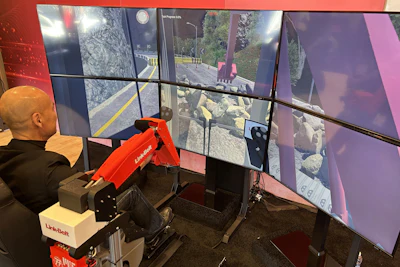
Engineers at the Massachusetts Institute of Technology have developed a new method for operating excavators, replacing joysticks with a mechanical arm that mimics the excavator’s arm and bucket.
The engineers developed the new control device for a training simulator to help new operators learn quicker. MIT partnered with Sumitomo, owner of Link-Belt, on the project.
In a test of its new simulator, MIT researchers determined that novice operators achieved the same results as experienced operators on the simulator. On a simulator with traditional joysticks, novice operators were way behind experienced operators.
The device could possibly be used in real-life operation, says Hermano Krebs, principal research scientist in MIT’s Department of Mechanical Engineering.
“Instead of having joysticks, you might have this miniature arm on the side, where the operator would place their own arm, kind of like an exoskeleton, which would allow them to operate the excavator in the cab,” Krebs says. “If work has to be done in a difficult or unsafe environment, you could have an operator sitting off-site in a trailer and using this arm to remotely tele-operate the excavator.”
(To see the mechanical arm simulator in action, check out the MIT video at the end of this article.)

 Powered by
The Simulator
Krebs began working on the project in 2018 after forming a collaboration with Japan-based Sumitomo Heavy Industries to shorten excavator operator training.
In Japan, as in the U.S., experienced operators are retiring, and younger workers are needed to replace them but lack experience. There is also a long-term worker shortage in construction.
Instead of using joysticks for the MIT simulator, trainees grasp a mechanical arm and use their arm and hand to make it move the way an excavator does, according to MIT. A digital excavator is projected on an immersive six-screen display and mirrors the trainee’s movements.
“This is a more intuitive way to command the machine,” Krebs says. “With this new interface, we can eliminate a lot of the mental maps that an operator would need to build in order to operate an excavator.”


The engineers also developed software to pair the mechanical arm’s movements with a virtual simulation of an excavator. They call it the “World-Space Interface.”
“Normally, operators have to build a mental map of how to manipulate things in the world-space,” Krebs says. “But now, we can just mime picking up rocks or dirt, and the computer will do that translation to the world-space for us.”
The researchers conducted a study with volunteers using a traditional joystick-controlled simulator and the World-Space Interface. The novice and experienced volunteers operated in 15 virtual excavation operations one hour a day for seven days, including construction sites, highways, forest roads, riverbanks, mining areas, and urban and rural settings.
The results, according to MIT:
Novices using the joysticks were way behind the experienced operators but improved over time; whereas, the novices using the mechanical arm were just as good as experienced operators at the start.
“In this case, joysticks are a non-intuitive way to control and coordinate the machine,” says study co-author and MIT postdoctoral scholar Joao Buzzatto.
What’s Next?
Krebs and the MIT team continue to improve the simulator and are now working on adding haptics to give the operator a feel for the excavator’s forces when digging and performing other tasks.
“Haptics would make this an even more intuitive system,” says co-author and visiting engineer Solmon Jeong.
The engineers see the simulator as a more natural alternative to current simulators that use joysticks. It could even transform the way excavators are operated, they believe, enabling first-time operators to go to work immediately if the arm were installed in the cab or used remotely.
Here’s a video from MIT showing how the simulator works: