











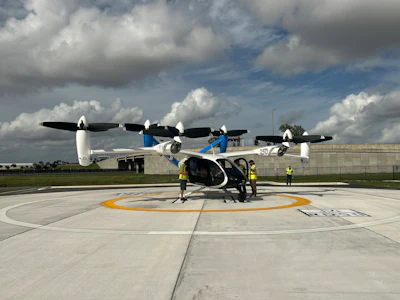
The Florida Department of Transportation is leaning into the state’s history of aviation innovation with two milestones in "electric vertical takeoff and landing aircraft" — nicknamed “flying cars” and also known as air taxis.
First, on October 30, Florida Governor Ron DeSantis presented a series of advanced air mobility flight demonstrations from FDOT in Tampa Bay, the first ever in the state’s history. Two “flying cars” took off from Albert Whitted Airport in St. Petersburg and flew in formation over Tampa Bay to Signature Aviation at Tampa International Airport.
(To watch a video of a "flying car" landing at Orlando International Airport, scroll to the end of this article.)
The demonstrations of the eVTOLs followed the same path as the first-ever commercial airline flight in the U.S., which Toby Jannus conducted on January 1, 1914. The flights were also the first to use Florida’s Aerial Highway Network, a first-of-its-kind network of dedicated aerial corridors connecting major hubs in the state.
A few days later on November 4, FDOT celebrated its second in the series of flying-car tests in collaboration with Joby Aviation, which used Orlando International Airport’s dedicated Vertipad for the first time. The specialized platform is the first of its kind in the country at a commercial airport.
 Powered by
The eVTOLs in the demonstrations look like helicopters with five small propellers instead of one, as some drones have.
The demonstrations are part of Florida’s “Future of Flight Series” mission, a fact-finding initiative in partnership with the Federal Aviation Administration to create regulations, infrastructure and operating procedures for safe commercial use of flying cars. Partners in the “Future of Flight Series” include OEMs like Joby Aviation and Beta Technologies, academia, local municipalities and several Florida airports.
The flights gather data on key flight aspects including noise and airspace integration and fall under the Federal Aviation Administration’s Electric Vertical Takeoff and Landing and Advanced Air Mobility Integration Pilot Program.


“FDOT, GOAA, the FAA and Orlando’s controllers spent two years proving in a simulator that an air taxi could fly into Class B airspace while the airport kept running,” said Gregory Bowles, Joby’s chief policy officer. “Today we demonstrated how quiet, electric, vertical-lift aircraft can integrate into existing airspace and how they will change how people move through a region like this one, from the gate to the parks in minutes instead of an hour on the highway.”