Their evolution into highly mobile toolcarriers has complicated matters for contractors interested in gauging large skid steer productivity. Thanks to the diversified array of attachments they carry, large skid steers rarely engage in consistent application roles on jobsites. They might begin the day moving earth, be cold-planing by lunch and running augers at quitting time.
In an earth-moving role, tracking productivity is straightforward: simply track the amount of earth moved in a given length of time. But when a skid steer is fitted with an attachment, productivity becomes a question of quickly completing one task and moving on to another.
Wide buckets can increase capacity, but beware of decreased maneuverability
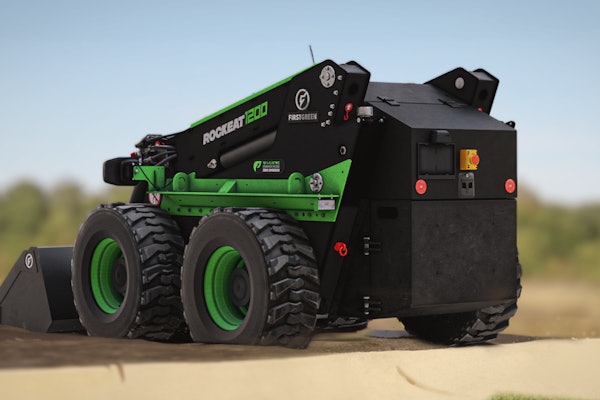
Because of their large size, skid steers with operating capacities greater than 2,501 pounds rub shoulders with “full size” machines such as backhoe loaders, wheel loaders and toolcarriers. They are typically employed in general construction roles such as site prep, landscaping, residential and utility work.
All of these machine types excel in specialized roles and can run a wide array of attachments. But skid steers have several advantages over backhoes and wheel loaders. Perhaps the biggest is their compact design, says Lance Schulz, loader product specialist, Bobcat. “Most contractors working in tight surroundings are going to turn to skid steers to get a large part of their work done,” he says. “Skid steers, even the largest models, can easily maneuver in tight working conditions. Just as importantly, they can move quickly through a congested jobsite and help keep a job’s pace moving forward.”
Another advantage is that large skid steers are ideally suited for smaller contractors with limited personnel and transportation resources. “Most backhoes require a large truck and a CDL to transport across town,” Schulz adds. “Neither is required for a skid-steer loader. You can put it on a 12,000-pound trailer, which can easily be pulled by a 1/2-ton pickup truck.”




Large skid steers are also a boon for small contractors who cannot afford large payrolls. “That’s really where the skid steer’s versatility as a toolcarrier comes into play,” notes Rusty Schafer, product manager, Case Construction Equipment. “We’re seeing an emerging trend for growth in the heavier end of our skid steers. That’s because labor is getting more expensive and contractors are trying to do more work with fewer people. These machines allow you to accomplish those goals while maintaining a faster pace on the jobsite.”
All of these attributes are true for skid steers regardless of their size. But large units have capabilities unknown to their smaller brethren. Higher horsepower ratings (from 60 to 110 horsepower) translate directly into more lifting capability and greater hydraulic power for running high flow attachments.
“Our machines, which are at the extreme top end of this line, have 3,600-pound lift capacities, more than 11 feet of lift height and radial-lift arm geometry,” observes Kelly Moore, product manager, Gehl. “This extra height and reach means they also have the ability to load the larger tandem and tri-axle dump trucks, which is something smaller skid steers cannot do. They also have the ability to use a 1-cubic-yard bucket, giving them productivity on par with a medium-sized backhoe.”
Moore admits you’re not going to have the full bucket sizing, breakout force or lifting potential you’d have with a backhoe loader, but says you can still be pretty darn effective. “The skid steer’s quicker cycle times, ability to turn within its own radius and responsive digging and loading more than compensate for those shortcomings,” he notes. “In many cases, a large skid steer can outperform a backhoe loader in that regard.”
As with any machine, spec’ing the proper bucket is crucial for productivity. Remember that high capacity doesn’t always equal high production, though. Spec a smaller bucket for denser materials.
Loader stalling out? Try a smaller bucket
Most skid steers with operating capacities greater than 2,501 pounds are fitted with low-profile or construction buckets 74 or 80 inches wide. “That’s an important point to consider,” Schulz says, “because you have to remember that the wider the bucket you use on your skid steer, the more you reduce the machine’s maneuverability. It’s kind of a break-even point. Don’t be seduced by large payload capacities. Remember that you can sometimes be more productive by using a smaller bucket. Big buckets do take more of a bite out of a pile. But if you’re losing time because you’re not going to be able to move the machine around the jobsite quickly you might actually be hurting your bottom line.”
“Construction buckets should be used in hard or rocky soil conditions and are a great general-purpose bucket,” observes Mark Hennessey, product manager, Mustang. “Utility and light material buckets are generally wider, have more material capacity and the back of the bucket is higher than construction buckets. These buckets are designed for use in softer or lighter materials such as wood chips, grain, feed and snow.”
Other popular buckets found on these machines are four-in-one buckets used by clean-up contractors, grapple buckets found in many recycling applications and low-profile landscape buckets, which are great for leveling, back dragging soil
and performing finish work where lawns are being installed in housing developments or landscaping around a new pool or house addition.
Because they are the largest in the line, these skid steers are limited when it comes to spec’ing bucket capacities. “It’s possible that you could use a bucket that’s too large for these models,” Moore explains. “You can overload any loader if you’re filling a large bucket to capacity with dense materials like gravel or wet sand. The cubic foot density is so much heavier than with dry dirt or materials used in landscaping.”
Another sign that you’re demanding too much from your large skid-steer loader is a continuously stalled engine, Schulz says. “If the loader keeps stalling out every time you push into a pile, it’s a good bet that the machine is being overworked, most likely due to operator error or because the bucket’s too large for the material at hand.”
Figuring out if you’re exceeding a machine’s operating capacity is fairly simple. If the machine is tippy with a full bucket – that is to say it’s a little light on the back wheels – it’s a sure sign that you’re overfilling the bucket. The solution to an over-loaded bucket is just as simple: switch to a bucket with a smaller capacity rating. “Once you do that, your overall productivity will improve dramatically,” Moore says. “You’ll be able to move around the jobsite quicker and your dumping cycle times will improve. In addition the loader will run better since you won’t be constantly pushing it to its operating limits.”
Vertical-lift linkage complements heavy payloads
Spec’ing the proper linkage can go a long way toward increasing a large skid steer’s productivity. Tradionally there are two common types of loader arm linkages available: vertical and radial-lift arm geometry. Recently, all skid steers in the 2,501 pounds operating capacity class and higher moved exclusively to vertical-lift geometry.
“This seems to be a logical progression for large skid steers, given their high-payload applications,” says Larry Foster, product manager, John Deere. “Vertical-lift geometry excels in load-and-carry bucket work. This type of linkage can generally lift heavier payloads higher than a radial-arm linkage system. In addition, vertical-lift arms do not extend outward as much as radial-lift designs as they raise upwards. This gives the skid steer a greater tipping capacity at full reach height. In addition, vertical-lift geometry has a greater number of pivot points in its linkage geometry, which may increase operating costs over the life of the machine.”