If you are a construction company owner or manager, hiring your first equipment technician is a step not taken lightly. After all, servicing and repairing machinery is not how you make money. And most of today’s equipment dealers offer such comprehensive maintenance and extended warranty packages you could run equipment for years and never have to touch a wrench or change a filter.
But sooner or later most contractors realize they can’t expect the dealer’s technician to do everything they need exactly when they need it. Contractors tell us it’s not the price of the dealer’s labor that drives them to look for their own technicians and it’s not the cost of putting a technician on the staff either. The single most critical factor that motivates contractors to hire their own technicians is uptime – equipment availability.
Why hire?
“Your own guy is available when you need him,” says Dick Kessel, of Kessel Construction, a Pennsylvania-based design-build general contractor. “You can work him overtime. You can say, ‘We absolutely need it by tomorrow morning,’ and it gets done.'”
The extension of the construction season into what used to be the off-season has also affected the way contractors think about uptime and technicians. “We used to have downtime from November to April,” says George Forni, president of Aquatic Environments in Alamo, California. “The operators would come back in and service their own machines at the end of the season. Then we started working through January and had very little downtime, so the equipment was starting to suffer. It was costing more to go out and fix it in the field than it would to service it here.”
Initially Forni says he struggled with having to hire a technician at $25 an hour and outfitting him with a $35,000 service truck. “But once I got over the hump and realized how much it was costing me in downtime by not having that person, then it was a simple decision,” he says. “Once you hit that point when your operators or your off season don’t allow you to do the necessary service, then you need a mechanic.”

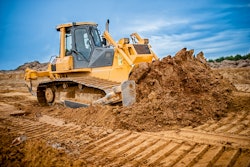

Another benefit to having your own technician on hand is that it gives you the ability to fix little things before they turn into big problems. Gregg Perrett, president and owner of Perrett Construction in Valentine, Nebraska, keeps three to four technicians busy working on his fleet of around 40 machines. “I ask our guys to fix everything, even the dash lights, and not just the immediate problem,” he says. And by going over his machines with a fine-tooth comb, Perrett’s technicians keep close track of hours and know well in advance before any major work is needed. “We don’t have many component failures in the field anymore,” he says.
Wages for equipment techs
According to the U.S. Bureau of Labor Statistics, in 2002 the median hourly earnings of mobile heavy equipment mechanics were $17.29. The middle 50 percent earned between $14.13 and $20.88. The highest 10 percent earned more than $24.90 while the lowest 10 percent earned less than $11.54.
Median hourly earnings paid by industry segment were as follows:
- Federal government–$19.44
- Local government–$18.03
- Other specialty trade contractors–$17.72
- Machinery equipment wholesalers–$17.10
- Equipment rental and leasing companies–$15.81
Breakeven points
Every contractor evaluates downtime differently, so no one formula fits every business model. One standardized way to measure how cost-effective it could be to hire your own technician is to look at the total number of labor hours you are paying a dealer or others for mechanical work, says Jim Wright, president of Fleet Counselor Services, a fleet certification and consulting service.
Wright, whose company sells a web-based service (see the Sources box at the end of the article) that evaluates the efficiency of and certifies equipment fleet shops and maintenance practices, says once you start contracting out more than about 1,000 hours of mechanical work, you need to start thinking about hiring your own technician. A mechanic in a private fleet or government fleet will give you about 1,500 hours in a year of direct productive time,” Wright says. “The rest is spent in training, vacation, holidays, leave, cleaning up, paperwork and things like that.”
Additionally, you need to look at more than just shop hours before hiring shop help, Wright says. “You need to evaluate and manage the average age of your machines by class. Often, instead of hiring a body, what you should be doing is replacing some of your older vehicles. With older equipment dependability is an issue, your parts inventory grows, and shop equipment and space needs grow,” he says.
Wright cites a client with a growing fleet who thought he needed to hire additional technicians and build a whole new shop facility. But by analyzing the age of the machines in the fleet and replacing some of the older, more labor-intensive vehicles with new machines, they were able to avoid the cost of adding technicians and building a new facility.
Where to find technicians
Every contractor or fleet manager we talked to mentioned word of mouth as the best way to find technicians. All of them also use help-wanted ads and other tools as well, but when it comes to recruiting new technicians, the old adage still holds true – it’s not what you know, it’s who you know.
“The first thing I do is let my technicians know we’re looking to hire,” says Marilyn Rawlings, the fleet management supervisor for Lee County, Florida. “These guys have been around for a long time and they know who’s out there, who is looking and who could be looking if we sweetened the pot enough.” Networking with other fleet managers also helps, Rawlings says. “If I interview a guy who is good, but turns out to be the number two candidate for a position, I’ll let my peers know about him,” she says.
Local technical colleges also churn out plenty of young, well-trained technicians. But if you’re looking to hire your company’s first technician, you may want to consider somebody with more hands-on experience than a new graduate. A lot of contractors we spoke to hire kids who grew up on farms or around machinery. For these youngsters, fixing equipment is second nature. But for your first technician, you’ll either need someone with experience, or be prepared to do a lot of supervision.
Also understand you’ll face a lot of competition from equipment dealers and other construction firms when it comes to recruiting technicians out of school. Dealers and contractors with big shops often give scholarships or help pay for the tools of students in return for a guaranteed period of employment after graduation.
Another often-overlooked source of good help are retirees and older candidates. Not all senior citizens may want to work the night shift of a grueling 60-hour workweek, but most of them have an encyclopedic knowledge of their craft not to mention maturity, experience and the ability to manage younger people. Rawlings says one of the best hires she ever made was a guy who had already put in 30 years with Detroit Diesel and Allison. “Everybody in the world wanted him,” she says.
AEMP
The Association of Equipment Management Professionals is an organization that promotes the education and development of equipment technicians in the heavy construction industry. It sponsors technical and managerial seminars throughout the year at local and national meetings and offers a curriculum and testing for the Certified Equipment Manager designation, the only recognized national standard for judging the qualifications of heavy equipment fleet managers.
Fleet Counselor Services, Inc.
This web-based program is designed to analyze the efficiency of vehicle and heavy equipment fleet utilization and maintenance. The test has 18 categories and each category has a detailed implementation plan that walks users through examples of how to improve their operations. The service also has 200 downloadable pages of editable policy and procedure documents on fleet management as well as other tools such as a downtime calculator, staffing calculator and a facility sizing calculator all based on your specific fleet makeup and age. For more information call (800) 824-0842.
ASE
The goal of the National Institute for Automotive Service Excellence is to improve the quality of vehicle repair and service through the testing and certification of repair and service professionals. Although primarily focused on the automotive field, ASE has recently added a medium/heavy truck test and a test for electronic diesel engine diagnosis.
The 21 Laws of Leadership
John C. Maxwell is an author and speaker on the topic of leadership and the founder of Maximum Impact, a company that teaches leadership skills. His company sells “Learning the 21 Irrefutable Laws of Leadership” a four-hour video/DVD series of lessons that includes guides for participants and facilitators.
Evaluating candidates
Judging a job candidate’s technical proficiency is relatively easy. What’s harder to discern and much more important is that person’s personality and character.
“The bottom line is you want to hire a good person,” Kessel says. “The more background checks you do with former employers, the better off you are. Attitude, enthusiasm, basic honesty and knowledge – those are the primary ingredients for any job you have.”
Forni emphasizes that the technicians you hire have to get along well with your work crews and operators. “You don’t want friction between your technicians and your operators,” he says. If you do have personality clashes, when something breaks the operator will blame the technician and the technician will blame the operator. Forni puts all his new hires on a 90-day probationary period to avoid this problem.
With a fleet of some 1,500 vehicles (cars and pickups included) and a shop with about 20 employees, Rawlings says her crew is like a family. Being able to fit into this culture is key to any new hire. “It takes a certain mentality to blend into that kind of environment,” she says.
One way to gauge how well the prospective employee will fit in is to do panel interviews that include other members of the maintenance team. “I never hire based on my opinion alone,” Rawlings says. And while technical questions are part of the interview process, Rawlings says the interview is also a good time to check attitudes. “I’ll ask them to tell me about the best supervisor they’ve ever had, or I’ll throw them for a loop and ask things like, ‘What’s the most bizarre thing you’ve ever done at work?'”
Skill sets
Obviously you want to hire a technician who can do the specific mechanical work and maintenance you need for your fleet. But don’t overlook other skills as well.
Rawlings requires all her technicians to have a Class B (air brake) commercial driver’s license. Welding is another skill that comes in handy in the shop. Truck maintenance and repair is also a fairly specialized field and one that is always useful in any construction company. Forni’s Aquatic Environments uses a lot of custom-built dredges, so it was important for him to have a technician with hydraulic cylinder and pump experience.
You also have to decide what components can be repaired economically in your shop and what is better off outsourced to a dealer or specialist. A lot of engine and transmission rebuilds get sent to the dealerships. And today’s hydraulic systems are so complex it often takes an expert to troubleshoot and repair them. “I try to hire to our weaknesses,” Rawlings says, “but I don’t get too hung up about it. Sometimes it’s easier to outsource something like hydraulics rather than try to train somebody in your shop.”
Keeping, motivating and promoting
A complaint sometimes heard from contractors is their competitors lure away their employees for the promise of a few cents more. If that’s the case you have to ask yourself if the real problem is money. “There has to be something more keeping them there,” Rawlings says. “If somebody offers $8 an hour more, you can’t fight that, but you can fight 10 cents an hour.”
First, you have to offer a decent package of benefits: medical insurance, 401K savings or profit sharing and paid vacation. Without these, not only will you likely suffer from a lot of turnover, but you’re unlikely to attract the most talented people to begin with.
Second, you have to create a work environment where people want to come to work and feel appreciated for the work they do. “Money will get them here,” Rawlings says, “But caring about them will keep them here.”
Rawlings, whose background was in business management rather than fleet maintenance, also takes time to celebrate and have fun – like setting up a dunk tank in the shop for an afternoon of fun and recreation, and occasionally wheeling her Harley Davidson into the shop to break up the day-to-day routine. “People ask me, ‘how can you afford to take an afternoon off with a dunk tank or spend an hour a week and do Maxwell’s 21 Laws of Leadership?’ And I tell them I’ve gotten more bang for my buck doing those kinds of programs.”
Challenges can also be motivating, says Rawlings. As an example she cites a situation several years ago when they needed one more technician to get his ASE certification (see Skill Builders box on page 36) to earn Lee County the Blue Seal Shop award. She had two candidates who had the qualifications but who didn’t do well on tests. “I asked them ‘Which one wants to be the fleet hero?’ and said ‘If either of you passes the test we’re going to get a big cake and have a day in your honor.'” The more experienced technicians pitched in to mentor the two. Both of them took the test and both passed, earning the shop the coveted award.
Giving business cards to all of the shop’s employees has also been an effective motivator, Rawlings says. Technicians put their business cards on the dash of vehicles they’ve serviced as a measure of accountability and professional pride. “One of the guys we gave business cards to was practically in tears,” she says. “He was 58 years old and nobody had ever given him a business card before.”
Listening to feedback is also an important component in creating the right kind of work environment. “I interview every one of my staff each year and ask them what they think is going well, what isn’t and what I could do to make their job better,” she says. Employees are also encouraged to speak forthrightly at team meetings as long as everyone knows that a consensus must be reached and accepted once the meeting is over. This open style of management is uncomfortable for some, Rawlings admits, which is why you want to look for people who can interact well.
Upward mobility
As your business and fleet size grows, you will eventually need to add more technicians. Some people have the aptitude to manage and some don’t, but Rawlings says it’s imperative
the employees you want to promote get training in management.
Among other tools, Rawlings uses the John Maxwell video series on leadership as a training tool. She’s also taken her leadership team to meet Maxwell (and Maxwell has also written about her experience.) Another component of Rawlings’ leadership training is to make sure managers are grooming their subordinates to eventually move up. Everyone in the shop also has a personal growth plan for his or her future. “If I’m doing my job right, I should have them at the point where it is seamless when I leave,” she says. “And I also want them to be able to replace themselves at the next level. If we start at the top and do it right, we’re all going to reproduce ourselves all the way down the chain.”