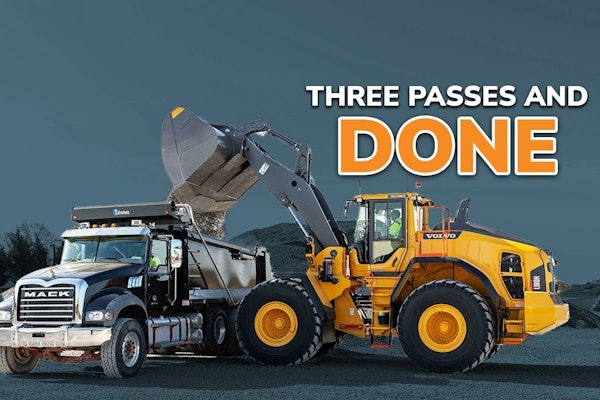
When the Environmental Protection Agency’s Tier 3 regulations for 100-175 horsepower off-road vehicles take effect in January, it will mark a transition period for wheel loaders with 135 to <175 net horsepower. In anticipation of Tier 3 standards, several OEMs have either released updated versions, or will do so in 2007.
There are no major cosmetic changes to these machines – their overall structure and mechanics will remain the same – but the engines and combustion technology have been refined.
"Electronics will be modified, particularly in the trubocharging system, fuel injection systems and electronics," says Dave O'Keeffe, product market manager for John Deere's 4WD loaders. "As you talk about different competitors, their execution will be slightly different, but the biggest change will be in the engine and the cooling packages."
As a byproduct, some wheel loader models gained extra engine power and jumped to the next class. The reason for this according to Nick Tullo, Volvo's North American market communicator and product specialist for haulers and loaders, is to give customers productive machines for their jobsites.
"The customer demand is just higher for this size machine and the customer wanted to see these machines do more," he says. "Because of that demand, manufacturers realize more horsepower is better and that is what the customer wants to see."
Wheel loaders excel in construction applications such as material handling, digging, load-and-carry, road building or site prep. Some models even come in waste handling versions. They use either the Z-bar or the tool carrier linkage. The Z-bar has a single bell-crank hydraulic cylinder that maximizes breakout force at the tip of the bucket. They tend to be high production machines with faster cycle times than those with tool carrier linkage. This allows operators to get into a pile, raise the load and dump it faster.
"The strengths of wheel loaders in this class are the maneuverability and versatility to perform multiple tasks along with low costs," says Cedric Gold, product marketing manager for medium wheel loaders, Caterpillar. "This is a bread-and-butter machine; a daily machine and a great start for new contractors. This machine will do what it was designed to do, and the best way to maximize the return on investment is to have the correct equipment size to meet production needs."
"The main thing is the big demand for this size wheel loader," adds Dave Wolf, product manager, Case Construction. "They are the wheel loaders with the highest industry demand because they are maneuverable and have great lift capacity and versatility."
A number of features
Operator comfort received a great deal of attention from manufacturers. The current trend is roomier cabs with easy-to-reach controls, extra glass for better visibility and extra storage space.
“Comfort is a major factor for the operator,” says Eric Winkler, brand marketing manager for New Holland. “They think about comfort inside the cab and also the comfort of servicing and maintaining the machine. That is why you want to design great visibility in and out of the cab, switches that are easy to read and valves to drain fluids easily.”
“The cab is the operator’s office,” says Gold. “A comfortable cab is the place where the most efficient job can be done. A machine is a production investment and it is making money only when it is working.”
Around 2003, a few wheel loader manufacturers replaced torque converters and powershift transmissions with hydrostatic drives.
“With hydrostatic drive we were able to put the engine in a transverse position since we no longer needed to concern ourselves with drive shafts and drivelines that require a longitudinal placement,” says Lowell Stout, senior product manager, Terex Construction Americas. “The latest numbers supplied by manufacturers of hydrostatic drive systems indicate they are up to 10 percent more efficient than conventional torque converter drive systems.”
WHAT’S ALREADY HERE
These models were updated this year.
Case E Series
In August, Case released its E Series line of wheel loaders with the 721E, the 721E XT and the 821E. The 721E’s increased engine power generates 183 horsepower, compared to the 170 of the 721D. The 721E is the standard 2-bar wheel loader and the 721E XT is the integrated tool carrier.
On current models, the engine is toward the rear of the machine, which serves as a counterweight to provide better balance and a smoother ride. E Series engineers also redesigned the glass in the cab for better visibility and a clearer view of the bucket. There are quick drain valves in the rear of the machine for oils and hydraulic fluids. These designs add up to a wheel loader built for increased productivity. “We designed these wheel loaders for 10 to 20 percent improvement in moving materials and better fuel economy so contractors can be more profitable,” Dave Wolf says.
Caterpillar 930 G and IT38GII
Caterpillar updated the IT38G Series II Integrated Toolcarrier earlier this year with changes to the engine’s method of combustion, performance and electronic systems. Caterpillar focused on the extras with this machine such as quick drain valves, safety features such as wider or angled steps and improved cab space and comfort. The update of this wheel loader bumps its horsepower to 180, but the IT38G II Waste Handler is rated at 160 horsepower.
“We built the IT38G so that a customer can perform dozens of applications in a job site, from truck loading and back filling to handling pallets and snow removal,” Cedric Gold says. “That versatility along with its capability of moving by its own means make this machine an important tool on most jobsites.”
The 930G uses a VersaLink linkage, combining the power and breakout forces of traditional Z-bar linkages with the versatility of a tool carrier. The VersaLink also has a high lift boom version with an additional 19 inches of dump clearance.
Kawasaki 70ZV-2 and 70TMV-2
Kawasaki introduced the updates of the 70ZV-2 and 70TMV-2 with an integrated tool carrier in late 2006. (The ‘V’ in the nomenclature stands for the Roman numeral V, not the letter.) The 65ZV-2 and 65TMV-2 tool carrier will be updated in the first quarter of 2007. There will be a few changes to the appearance of Kawasaki’s wheel loaders. Most of the changes are in the dual power modes, adjustable declutch system and a focus on maintenance with a gull-wing door design that allows access to the engine compartment.
“The gull wing hinges on the top for better engine access,” says Gary Bell, vice president and general manager of Kawasaki Construction. “These machines are small enough that a gull wing door is practical. With bigger machines, the door gets so big you can’t hold it up. But the gull wing provides a big opening and the whole side of the engine compartment is accessible. With a standard side hinge door, you have to leave room for the hinge, which closes off some of the opening.”
Where other OEMs increased horsepower in their engines, Kawasaki focused on boosting torque. The thinking was that while boosting horsepower may be beneficial in some ways, a boost in torque is where the operator will feel the power of the machine.
“Increasing torque allows us to enhance the performance of the machine,” Bell says. “With electronic engines nowadays you can design your torque curve to be a little more customized to a given horsepower, so you don’t have to take whatever horsepower is given to you. You have a lot of flexibility to specify your torque range. An increase in torque was a main objective, not an increase in horsepower. With some of our machines, horsepower may have even gone down. You can have the same horsepower, but if you have higher torque, then the operator is going to feel the machine is more powerful.”
JCB 426 and 436
JCB has four models with new designs, but are not scheduled to be manufactured with Tier 3 engines until the first quarter of 2007. The 426 HT, 426 ZX 436 HT and 436 ZX were updated in May with 50 percent more cab volume than previous models and larger gull wing doors for easier access to the engine, filters and grease points for maintenance among other improvements. These changes will continue when the Tier 3 models are released.
“The changes were driven by Tier 3 improvements with our larger machines,” says Dave Hardwick, heavy line product manager for JCB, “but they have already been incorporated into this size class. We have refined the service access on the machine to make daily checks and maintenance easier while the larger cab has been really appreciated drivers.”
What’s coming
Several OEMs are releasing new models in 2007. While they are tight-lipped about any innovations they may introduce, there are a few features certain to appear with these updates.
John Deere currently has the 544 and 624 in this wheel loader class, but will update these models to Tier 3 standards with its J-Series in the early part of 2007. “The features we focus on are ones that impact productivity, uptime and lowering operating costs,” says Dave O’Keeffe. “From a production standpoint, we try to have machines with strong engine power and fuel efficiency.”
New Holland’s current models in this class – the W170 and the W190 – will be joined by an update of the W130, set for a March 2007 release. The W170 was updated in October, but the W190 moves up to 213 horsepower. Like other OEMs, the W130 will focus on improving performance and operator comfort, with promises of improved seats, control access and visibility to the bucket. As with this generation of wheel loaders, New Holland is focused on making the machine easy to service and maintain. “We have moved to environmental-friendly fluid drains on the outside of the machine,” Eric Winkler says. “We want to make it easy to service and maintain this machine.”
Komatsu has the WA 250 and the WA320-5 currently on the market, but will release updates of both mach-ines sometime during the first quarter of 2007. Komatsu introduced a hydrostatic transmission, improved hydraulic system and torque converter in 2003. The new models will keep these changes and focus on improving performance. “piuopijukWe don’t want to shock the customer,” says Michael Gidaspow, product marketing manager for wheel loaders for Komatsu. “When we built the WA320-5, we saw an increase in productivity with it and fuel consumption decreased. The standards introduced are driving us to improve our technology. We are doing our best to increase our performance when we introduce new machines.”
Volvo’s L60E, L70E and L90E will all be updated with Tier 3 specs and a few cosmetic changes. Expect the debut of the L60F, L70F and L90F sometime in January. The rear of the machine will have a different shape and the outside appearance of the cab will be a bit different, but the inside of the cab will offer more changes. “The cab is the main focus for these smaller machines,” Nick Tullo says. “Greater visibility is key with this sized machine. When you are out in the yard, you do material handling with this size machine, so we really opened up the cab with floor to ceiling glass and there is a lot more room in there also. There are so many different things we had to do by going to Tier 3; we wanted to change the cab, look and feel of the machine.”
Terex’s SKL260 was renamed as the TL260 in 2006. The current TL260 still has a Tier 2 engine, but you can expect an update closer to mid-2007 as soon as the current engine inventory runs out. The current features of the TL260 will move to the next generation. With this machine, Terex wanted to expand its line of hydrostatic wheel loaders and the horsepower for this wheel loader will be at the top of this class at 175.
Liebherr will update its L538 and L544 sometime in the first quarter of 2007. It is likely that the new line of wheel loaders will have a new nomenclature, but as of press time that information has not been released. There will be a change to the drive systems with these wheel loaders and serviceability will be similar to the larger wheel loader models.
The Daewoo brand will chan-ge to Doosan in 2007 and the new models of wheel loaders released will bear that name. Also slated to change are the Mega 200 and Mega 250 V wheel loaders. In addition to Tier 3 engines, the updated models will be designed for better fuel economy and reduced noise levels due to a double walled muffler, a new exhaust pipe, a new variable speed cooling fan and tighter seals inside the cab. Ground-level greasing points and a site glass for all the major fluid check points are area designed to assist with maintenance.